
The AI in fintech market is growing fast. Banks and fintech companies are using artificial intelligence to improve customer service, reduce fraud, lower costs, and make faster decisions. AI solutions and efficient financial solutions are key drivers of innovation and operational improvements in the fintech industry, enhancing security, compliance, and customer engagement.
AI tools like machine learning, natural language processing, predictive analytics, and generative AI are now common in payments, lending, investing, insurance, and compliance. Financial technology is transforming the global market by integrating AI solutions across banking, payments, and investment sectors, driving automation, risk management, and customer insights.
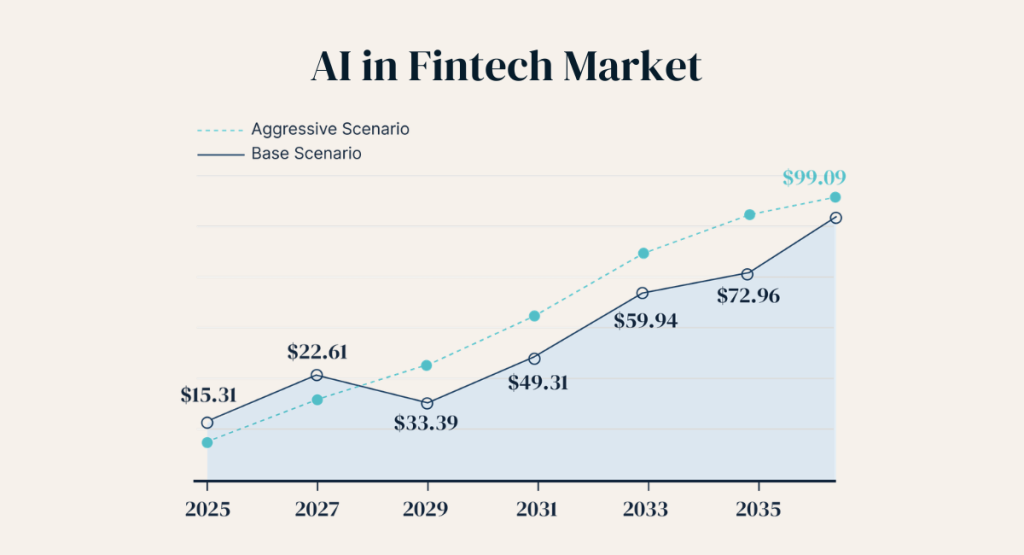
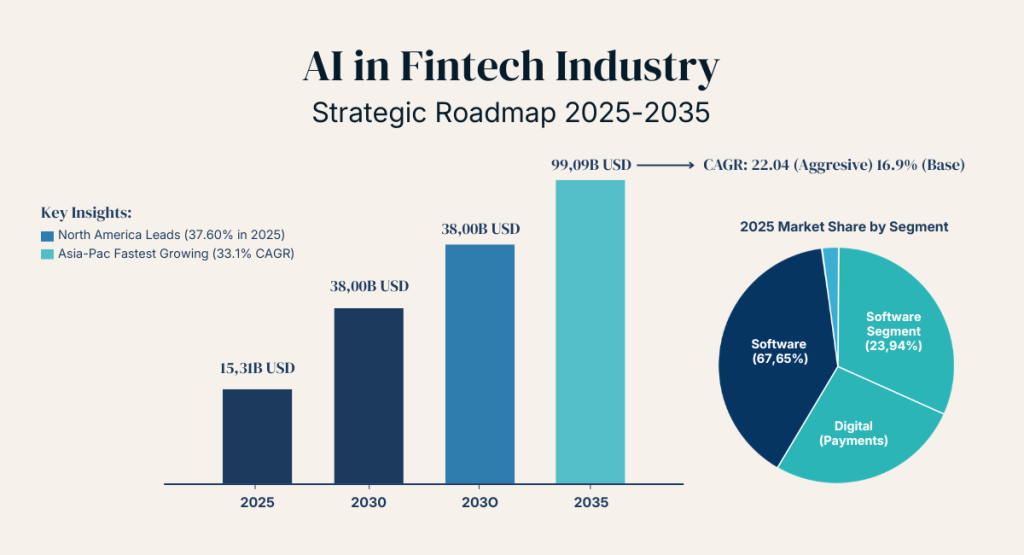
The global AI in fintech market is expected to grow from USD 15.31 billion in 2025 to USD 72.96 billion by 2035, with a CAGR of 16.9%. Some forecasts show even faster growth, reaching USD 99.09 billion by 2031 at a CAGR of 22.04%. The AI in Fintech market is expected to reach USD 36.61 billion in 2026 and expand at a 22.04% CAGR, reaching USD 99.09 billion by 2031.
North America is expected to hold 37.60% of market revenue in 2025, thanks to strong financial infrastructure and clear regulations. Asia-Pacific is projected to grow the fastest, at 33.1% CAGR through 2031, driven by mobile payments and generative AI investments.
The software segment will account for 67.65% of revenue in 2025, driven by high demand for AI-enabled platforms, while digital payments are expected to capture 23.94% of the market revenue share in 2025, fueled by the rise of cashless transactions.
Major companies such as PayPal, Block, Inc., and International Business Machines Corporation are leading AI innovation in fraud detection, risk management, and customer analytics. The global market is characterized by a dynamic competitive landscape, driven by rapid technological advancements and increasing demand for personalized financial services.
This report covers 2025–2035 and is designed for financial institutions, fintech companies, investors, technology providers, and regulators, highlighting the importance of understanding fintech market growth and the evolving global market landscape.
Metric | 2024 Value (USD Bn) | 2025 Projection (USD Bn) | CAGR to 2030/2033 |
Global AI in Fintech | 15.4-17.64 | 17.93-30 | 16.5-22.6% |
U.S. AI in Fintech | 10.96 | N/A | 32.16% (to 2032) |
Generative AI in Fintech | 1.61 | 2.17 | N/A |
AI adoption in fintech is being driven by five major factors: growing digital payments, rising fraud risks, demand for personalized services, compliance pressure, and the need to reduce costs.
The market is expanding quickly. It is projected to reach USD 72.96 billion by 2035 under the base forecast. In a faster growth scenario, it could reach USD 99.09 billion by 2031.
Near-term CAGR projections range between 16.9% and 22.04%.
The top three priorities for financial institutions are improving fraud detection, scaling personalization, and strengthening AI governance frameworks.
Fintech refers to technology used to improve financial services. AI is now a core part of fintech growth.
Machine learning helps detect fraud. Natural language processing powers chatbots. Data analytics helps banks understand customers better. Generative AI is helping automate content, risk analysis, and reporting.
Digital banking and online payments continue to grow worldwide. According to the World Bank, financial inclusion and digital finance are key drivers of global economic growth. You can read more about financial inclusion at:
https://www.worldbank.org/en/topic/financialinclusion
As customers expect faster and more personalized services, financial institutions are investing more in AI technologies.
On the demand side, financial institutions want better customer experience and real-time insights. AI helps them respond faster to fraud, credit risks, and market changes. AI-driven data analysis of financial data enables more accurate and timely decision-making, supporting risk management and regulatory compliance.
AI also supports financial inclusion. By analyzing alternative data like utility payments and transaction history, lenders can assess people who do not have traditional credit records. AI uses credit history and other financial data to improve credit scoring models, broadening access to credit and reducing reliance on traditional credit histories. The International Monetary Fund highlights the importance of digital finance in expanding access to banking services: https://www.imf.org/en/Topics/fintech
On the supply side, fintech firms face challenges. These include AI talent shortages, data privacy regulations, and complex system integration.
Open banking rules are also changing the competitive landscape. The European Commission provides details on open banking frameworks here: https://finance.ec.europa.eu/digital-finance/open-banking_en
Understanding market trends through AI-powered data analysis is crucial for strategic planning and maintaining a competitive advantage in the fintech industry.
The AI in fintech market was valued at around USD 13 billion in 2024. It is projected to reach USD 15.31 billion in 2025 and continue growing steadily.
By 2035, the base forecast suggests USD 72.96 billion in market value. Alternative projections show faster growth reaching USD 99.09 billion by 2031.
In 2025, software solutions will make up about 67.65% of revenue. Services account for the rest. Digital payments alone are expected to represent 23.94% of the total market.
Forecast models include conservative (15.9% CAGR), base (16.9% CAGR), and aggressive (22.04% CAGR) scenarios.
Funding Period | Global Fintech (USD Bn) | AI-Specific Highlights |
H1 2025 | 24 | AI mega-rounds, e.g., Tipalti $200M |
Q2 2025 | N/A | Focus on AI agents and automation |
Machine learning is used for fraud detection, credit scoring, AML monitoring, customer segmentation, and algorithmic trading. Machine learning algorithms are central to risk management, fraud detection, and enhancing financial decision-making in the fintech industry.
Supervised learning models are often used for fraud classification and credit risk prediction. Unsupervised learning is used for anomaly detection and clustering.
Model validation is important. Institutions use cross-validation, ROC-AUC monitoring, bias testing, and model drift detection.
You can learn more about machine learning basics from the National Institute of Standards and Technology AI resources: https://www.nist.gov/artificial-intelligence
Advancements in machine learning algorithms and regulatory technology are expected to drive a 15.9% CAGR in the AI in Fintech market between 2025 and 2035.
NLP powers chatbots, document processing, KYC automation, and regulatory analysis.
Banks set clear accuracy targets. For example, intent detection above 90% and document classification above 95%.
Explainability is critical. Regulators increasingly expect AI transparency. The European Commission provides guidance on trustworthy AI:
https://digital-strategy.ec.europa.eu/en/policies/european-approach-artificial-intelligence
AI helps banks track transaction patterns, product usage, and engagement levels. AI-driven data analytics also supports the development of personalized investment strategies and enhances asset management services by providing deeper insights into client needs and behaviors.
Dashboards segment customers by spending behavior, credit utilization, and marketing response.
Data preparation steps include cleaning, normalization, feature engineering, and bias mitigation. High-quality data improves model accuracy and fairness.
By understanding customers’ spending habits, investment preferences, and interaction patterns, financial institutions can tailor their offerings, including asset management and investment strategies, to meet individual needs.
AI-driven trading requires very low latency and strong risk controls.
Key safeguards include kill switches, drawdown limits, volatility filters, and position caps.
Backtesting and stress testing are conducted regularly to reduce unexpected risks.
Alternative data sources include utility payments, transaction history, mobile usage patterns, and behavioral analytics. AI leverages credit history and financial data to enhance credit scoring models, making credit assessments more accurate and inclusive.
Performance is measured using ROC-AUC, Gini coefficient, and default prediction accuracy. AI utilizes extensive data, including transaction records and alternative data sources, to evaluate creditworthiness more accurately and inclusively.
Before rollout, scoring engines must pass bias testing, regulatory validation, and explainability checks.
The Bank for International Settlements provides insights into AI and credit risk: https://www.bis.org/fsi/publ/insights21.htm
AI in fintech must comply with PSD3, AML frameworks, GDPR, and other regulations. AI technologies can automate compliance processes, reducing the risk of human error and ensuring adherence to evolving regulations.
Strong governance includes maintaining model inventories, version control, risk classification, audit logs, and independent validation. In 2025, compliance costs could account for up to 10% of total operational expenses for financial institutions, and institutions now allocate up to 30% of AI budgets to compliance activities, which can trim funds for innovation.
High-risk AI systems require detailed audit trails and clear explanations. The EU AI Act designates high-risk financial systems for stringent oversight, resulting in compliance patchworks.
Regulatory compliance presents a significant challenge for fintech companies implementing AI, as they must navigate fragmented regulatory guidance.
Banks use AI for fraud detection, personalization, and back-office automation. AI also improves the efficiency, security, and accuracy of processing financial transactions, enabling real-time payment processing and enhanced fraud prevention.
AI systems monitor transactions in real time to flag suspicious behavior. This improves security and reduces losses. AI-powered chatbots and virtual assistants enhance customer service by providing immediate, personalized support, transforming how financial institutions interact with customers.
Retail banks also use AI to recommend products and personalize offers.
Back-office automation improves compliance checks, document review, and reporting processes.
AI systems can handle routine inquiries and perform complex tasks, turning customer service into a value-added service. The demand for AI-powered customer service solutions is driven by the need for efficient customer interactions and the ability to manage high volumes of inquiries without additional staffing.
Customers include global banks, regional banks, fintech startups, neobanks, and SMEs.
Common pricing models include SaaS subscriptions, usage-based pricing, enterprise licenses, and managed services.
SME-focused packages often include ready-to-deploy fraud tools and compliance dashboards.
Cloud deployment offers flexibility and scalability. Hybrid models help meet regulatory requirements. On-premise setups are used for high-security environments.
Data residency rules vary by region. The EU emphasizes GDPR compliance. Some APAC countries require local data storage.
MLOps capabilities include performance monitoring, automated retraining, and drift detection.
The market includes hyperscalers, platform providers, niche AI startups, and financial services firms. Financial services firms are leveraging AI technologies to reduce operational costs and improve efficiency by automating routine tasks and delivering faster services, which helps them gain a competitive advantage.
Large technology firms provide AI infrastructure. Specialized vendors focus on AML, credit scoring, and RegTech. The fintech sector is increasingly shifting toward ‘solutions as a service,’ with 45% of fintechs now offering AI-based B2B solutions.
Partnerships between banks and fintech firms are increasing to accelerate innovation. The AI in Fintech market is characterized by a dynamic competitive landscape, driven by rapid technological advancements and increasing demand for personalized financial services.
Asia-Pacific is expected to grow at 33.1% CAGR through 2031.
China and India are major growth engines due to mobile payments and digital banking adoption.
Regional regulations often require data localization and strict compliance standards.
Key risks include cyberattacks, adversarial AI, model drift, and bias.
Privacy-preserving methods such as federated learning and encryption help reduce risks.
Bias testing is essential for consumer-facing AI models to ensure fairness.
The Organisation for Economic Co-operation and Development outlines global AI principles here:
https://oecd.ai/en/ai-principles
Three key investment areas are fraud prevention, generative AI for customer engagement, and compliance automation.
Financial institutions should build AI centers of excellence and train employees in data literacy.
A strong rollout plan includes defining KPIs, running pilot programs, monitoring bias, and scaling gradually.
This report is based on executive interviews, vendor briefings, institutional surveys, regulatory publications, and financial filings.
Forecasts use top-down and bottom-up modeling with scenario analysis.
Projections may change due to regulatory shifts and adoption rates. Annual updates are recommended.
AI: Artificial Intelligence
ML: Machine Learning
NLP: Natural Language Processing
AML: Anti-Money Laundering
RegTech: Regulatory Technology
CAGR: Compound Annual Growth Rate
MLOps: Machine Learning Operations
The AI in fintech market is reshaping global finance. Institutions that combine innovation, governance, and customer focus will be best positioned to lead in the next decade.
The rapid expansion of the AI in fintech market is reshaping the financial sector, as financial institutions and fintech companies increasingly leverage artificial intelligence to deliver more efficient, secure, and personalized financial services. By integrating advanced machine learning models, natural language processing, and data analytics, the fintech industry is able to address evolving consumer expectations, enhance risk management, and streamline operational efficiency.
With the global AI in fintech market size projected to reach USD 99.09 billion by 2031 at a compound annual growth rate (CAGR) of 22.04%, the momentum behind AI adoption is undeniable. The rising demand for digital payments, conversational AI, and tailored financial advice is fueling significant growth across the financial services industry. Financial companies are investing in AI technologies not only to improve customer satisfaction but also to reduce operational costs and enhance financial services delivery.
AI-powered solutions, such as virtual assistants and automated credit risk assessment tools, are enabling financial institutions to achieve significant cost savings, some estimates suggest reductions in operational costs of up to 30%. These AI algorithms also support more accurate credit risk assessment, allowing for better decision-making and more personalized financial advice, which in turn drives customer loyalty and trust.
However, as AI becomes more deeply embedded in the fintech sector, financial organizations must remain vigilant about data security and regulatory compliance. Protecting customer data and adhering to evolving regulations are essential for maintaining confidence in the financial services landscape. Responsible AI adoption, with robust governance and transparency, will be critical as the market matures.
Key companies such as International Business Machines Corporation, Microsoft Corporation, Amazon Web Services, Inc., Intel Corporation, and ComplyAdvantage Ltd. are at the forefront of AI innovation in the fintech market. Their ongoing investments in AI research and development are enabling financial institutions to leverage AI for more efficient, secure, and customer-centric solutions.
Looking ahead, the future of AI in fintech is bright. As financial institutions and fintech companies continue to embrace AI technologies, the industry is poised for further transformation, delivering enhanced financial services, reducing operational costs, and improving risk management. By leveraging AI responsibly, the fintech market will continue to unlock new opportunities for growth, innovation, and financial inclusion in the years to come.
Windsor Drake represents founders on the sell side only. Every inquiry is read and answered personally, usually within one business day, and every conversation is confidential and without obligation.
Discuss a potential saleWindsor Drake is not a registered broker-dealer and does not offer, sell or place securities.