
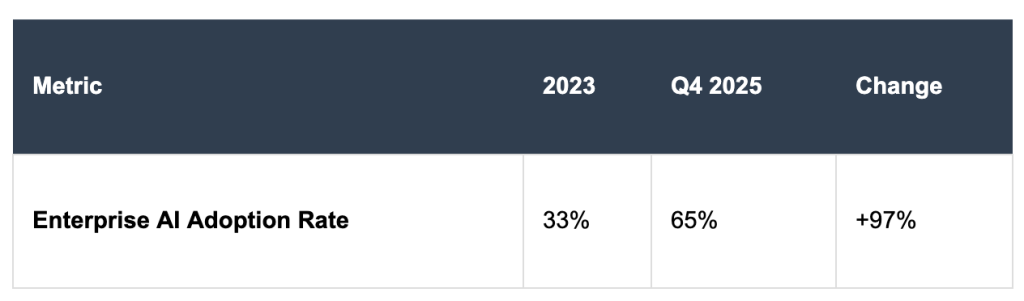
Let’s be honest. For a long time, “enterprise AI” meant a lot of flashy slide decks and very few production API keys. Q4 2025 changed that narrative entirely. The adoption metric jumped, hard. We witnessed enterprise adoption surge from a tentative 33% in 2023 to a robust 65% today. That isn’t just pilot purgatory anymore; that’s the C-suite demanding real ROI.
And where did that ROI finally show up? Code. Code generation has emerged as the undisputed heavyweight champion of GenAI use cases. It’s the first true “killer app” for the enterprise. It’s not just about autocomplete anymore; it’s about entire workflow orchestration.
“If you’re valuing a platform today and they don’t have a dominant code-gen story, discount them. Heavily.”
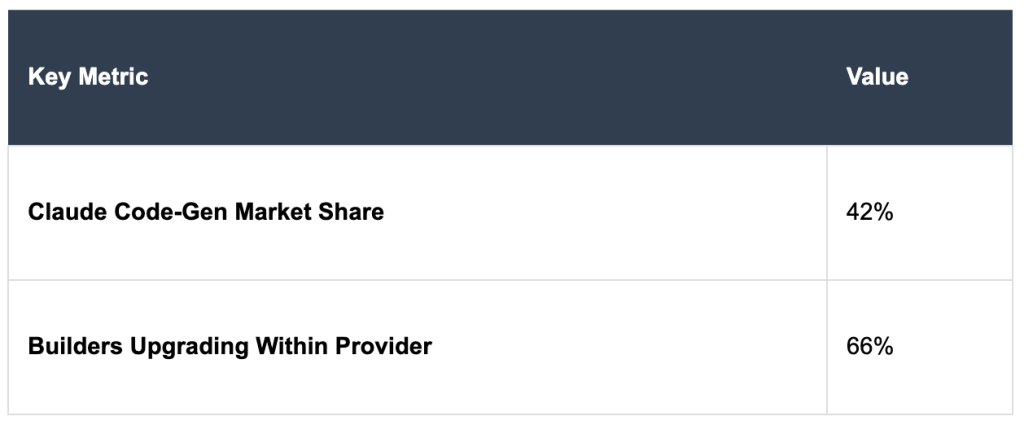
Claude captured 42% of this code-gen market share, edging out competitors not because it was cheaper, but because it understood the developer context better. When a tool pays for its annual contract in the first weeks of usage, the sales cycle compresses dramatically.
Here’s what the bears got wrong about Q4. They thought LLMs were becoming a commodity. They predicted a “race to the zero,” where prices would crash and margins would evaporate.
They were half right. Token costs did drop, falling nearly 10x in some infrastructure layers. But did buyers care? Surprisingly, no. The average deal size actually went up. Why? Because builders don’t care about saving pennies on tokens when the model hallucinates in front of a Fortune 500 client. They care about performance.
We saw a distinct “flight to quality” in Q4. Builders paid up for frontier models despite the cost drops elsewhere. When Claude 3.5 Sonnet and the latest GPT iterations dropped, teams switched in weeks, not months. 66% of builders upgraded within their existing provider immediately. They aren’t price sensitive; they are intelligence sensitive. In the enterprise AI game, smarts beats cheap every single time.
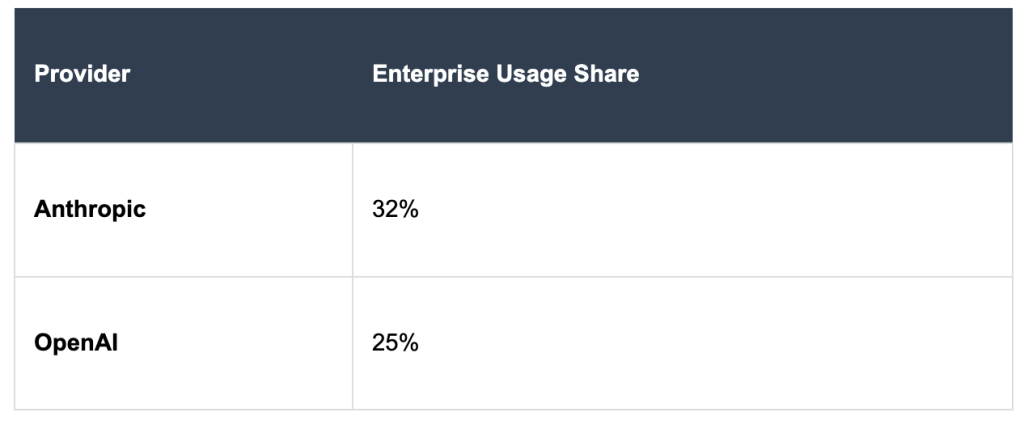
Two years ago, OpenAI was the default. It was the Kleenex of AI. Today, the enterprise map looks different. Anthropic has quietly, steadily captured 32% of enterprise usage share, edging out OpenAI’s 25%.
How did they do it? By being the “boring” option. Their safety-first positioning wasn’t just sexy marketing; it was a calculated GTM strategy that paid off in Q4. Legal teams love them. Compliance officers sign off faster.
When we analyzed deal cycles this quarter, Anthropic’s governance-first approach proved advantageous. Why? Because the governance was built in. They weren’t selling a black box; they were selling a risk-managed asset. In a regulated world, “Constitutional AI” is a massive competitive moat.
We sat in on the diligence calls. We saw the redlines. The friction point isn’t technical capability anymore, everyone has a smart model. The friction is governance.
Deals accelerated when vendors could prove lineage. “Where did this data come from? Can you prove you didn’t train on my IP?” If the answer was a shrug, the deal died. If the answer was a verified log, the check got signed.
Verified ROI and production readiness became the new baseline. Not the model weights, but the wrapper around them, the SOC2 reports, the private cloud deployment options, the guaranteed SLAs. That’s what accelerated closes in Q4. The market matured. It stopped buying magic and started buying reliable, governable infrastructure.
“The market stopped buying magic and started buying reliable, governable infrastructure.”
Let’s be clear: 20x revenue wasn’t a typo in Q4. It was the standard for the plumbing layer. If you were building infrastructure or core platforms, you commanded the room. Why? Because you own the rails. Buyers paid up for GenAI Platforms and Data Intelligence because they aren’t just tools; they are dependencies. Once installed, they don’t leave.
Data moats weren’t just buzzwords. They were verifiable assets. We saw premiums explode for companies that could prove exclusive access to proprietary datasets. If your model learns from data nobody else has, your valuation floor moves up. Period.
Cohort NRR above 120% was the golden ticket. In the enterprise segment, if your expansion revenue wasn’t covering your churn and then some, you were discounted. But those showing 125-130% NRR? They got the “quality premium.” Buyers looked at gross margins after model costs. If you were sitting above 75% with a clear path to 80%, you proved you weren’t just reselling tokens. You were selling software.
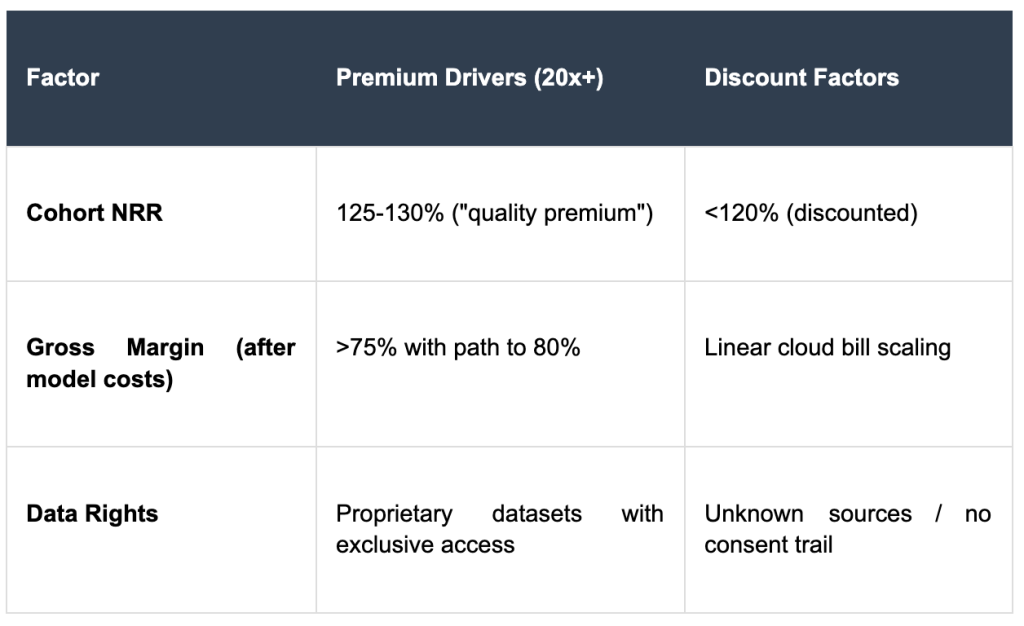
Where did pricing crumble? Ambiguity. If you couldn’t trace your data sources, you were toxic. “We scraped the internet” isn’t an answer anymore; it’s a liability. Buyers discounted heavily for unknown IP risks. If you couldn’t show a consent trail, the bid dropped, or disappeared.
Noisy usage killed momentum. Spiky revenue looks like risk. If your cloud bill scaled linearly with revenue but you had no leverage plan, margins looked terrifying. Buyers punished “wrapper” companies with no cost control. Open-source lag was another drag. If your proprietary model was barely beating Llama 3, why pay a premium? The market stopped paying for “me-too” LLMs.
Valuation gaps were wide. Founders saw the future; buyers saw the risk. The bridge? Structure. Earn-outs shifted from “fix-it” tools to aggressive growth incentives. We saw deals where 30% of the consideration was tied to post-close expansion. You think you can hit $50M ARR next year? Prove it, and we’ll pay for it.
Founder rollover became mandatory. In the hottest deals, PE firms and strategics didn’t want to buy you out; they wanted to buy you in. Retaining 20-30% equity wasn’t just an option; it was a requirement for the premium multiple. Continuity is currency. Minority structures also surged. Founders took chips off the table but kept control, betting on a bigger exit in 2027.
The diligence room changed in Q4. The demo deck is dead. Buyers stopped reading slides and started reading logs. They wanted to see live lineage graphs. They asked for the raw cloud bills, not the pro-forma projections. “Show me the savings plan,” was a common refrain.
Cohort breakouts replaced blended metrics. You couldn’t hide churn in a blended NRR number anymore. Buyers peeled back the layers: “Show me the Q1 2024 cohort. Are they growing?” If the answer was yes, the check cleared. If not, the meeting ended.
Ultimately, buyers tested for reality. They ran queries. They traced incidents. They audited the “AI” to see how much was human-in-the-loop. The companies that passed these tests didn’t just close; they set the high-water marks for 2025.
Buy governance, not just tech. The shiny model is a liability if it’s a black box. We saw deals stall in Q4 purely because lineage was fuzzy. If you can’t trace the data, you can’t deploy the asset. Period. Own the policy engine. Own the identity layer. That’s where the enterprise value lives.
Underwrite migration friction. It’s not plug-and-play. It’s plug-and-debug. Smart acquirers are budgeting for integration SWAT teams before the LOI is inked. They know the “seamless integration” on the roadmap is a lie. They plan for the 6-month refactor. They price it in.
Bundle for lift. Don’t model the target’s revenue. Model the attach rate. Use the acquisition to unlock tiered SKUs in your core product. Make the catalog the unlock for the premium tier. That’s the revenue synergy. Standalone GenAI tools are features; bundled suites are platforms.
Pursue platformability. Stop buying islands. Buy archipelagos. The new PE playbook is the “Shared Data Plane.” If your portfolio companies aren’t sharing a common connector framework, you’re losing leverage. Consolidate the back end. Keep the front ends vertical.
Sequence value creation. Don’t touch pricing until governance is fixed. In Q4, we saw firms try to raise prices on platforms with weak audit trails. Customers walked. Fix the compliance layer first. Then build observability. Then you earn the right to raise the ARR.
Build a tuck-in map. Connectors are cheap to buy but expensive to build. Look for the small, boring players who just do integrations well. Snap them in. It accelerates the roadmap by 18 months. Standardize the contracts. Clean DPAs mean clean exits in 2028.
The Agentic Shift is Real. The agentic AI market is projected to grow at ~150% CAGR through 2028. We are moving from “Chat” to “Work.” The models aren’t just answering; they are doing. Workflow automation is the next battleground.
APAC is the sleeper. While US/EU focus on regulation, APAC is deploying. Growth rates there are outpacing the West in industrial and manufacturing AI. Don’t ignore the East.
Categories to Watch:
Fix data rights. Now. Yesterday wasn’t soon enough. If your consent trail is broken, your valuation is zero. We diligence this first. If we find scraped data without usage rights, the deal is dead. No pivots. No excuses.
Ship audit trails. Logs are your new marketing. Enterprise buyers don’t trust your sales deck; they trust your splunk logs. Show them every pipeline execution. Show them every policy change. Make trust visible.
Normalize metrics. We don’t care about blended NRR. It hides the churn. Show us the Enterprise Cohort NRR. If that’s not >120%, you don’t have product-market fit yet. You have curiosity-market fit. There’s a difference. Price to land. Predictable baselines win over spiky overage models.
Diligence in 2026 won’t be about “How smart is the model?” It will be “How safe is the scale?”
Prove trust. Prove expansion. Show the path to cheaper scale.