Available exclusively to fintech founders, executives, and investors.
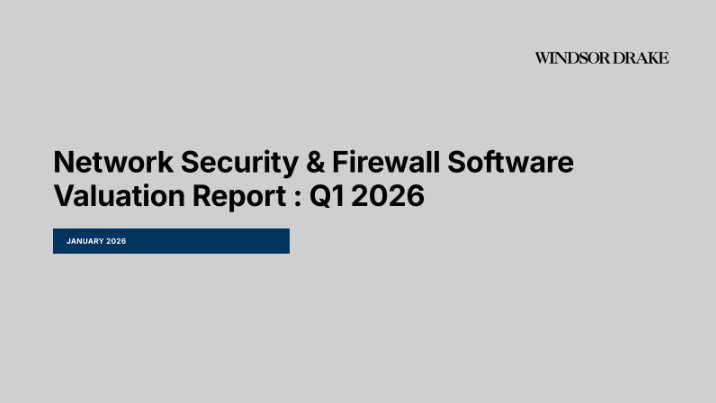
The global cybersecurity landscape has reached a pivotal moment as we move from late 2024 into the 2025-2026 forecast period. We’re seeing what can only be described as a “growth super-cycle” in the industry. But this isn’t just about companies spending more money. We’re witnessing a fundamental transformation in how capital gets allocated, how people define value, and how the market prices assets. This report, the Network Security & Firewall Software Valuation Report – 2026, breaks down these shifts with hard data, giving cybersecurity founders and enterprise leaders a detailed look at where the market is heading.
When we dug into Q4 2024 data, what jumped out at us was how dramatically the market has split in two. The old relationship between general IT spending and cybersecurity valuation? That’s broken. Instead, we’ve got a new valuation system that’s brutally honest about which companies matter and which don’t. It makes a sharp distinction between legacy infrastructure providers and next-generation, AI-native platforms. Sure, global spending on information security is set to jump from roughly $233.4 billion in 2024 toward $522 billion by 2026¹, but here’s the thing: this wealth isn’t being spread evenly. The market is throwing premium multiples at companies doing “platformization” (consolidating separate point solutions into unified security systems) while basically treating pure-play legacy vendors like commodities.
The story of the 2026 outlook comes down to three massive forces colliding: mainstream adoption of Agentic AI, Europe’s regulatory crackdown through NIS2 and DORA, and the final phases of cloud migration reshaping network security architectures. Here’s something striking: valuation multiples for “High Growth” vendors (companies growing revenue more than 20%) shot up significantly in Q4 2024, hitting a median Enterprise Value to Revenue (EV/Revenue) multiple of 14.3x. Compare that to just 4.7x for “Low Growth” incumbents³. This gap tells you everything about what the market values now: growth efficiency and technological defensibility.
Merger and acquisition activity has hit levels we’ve never seen before. It’s being driven by hyperscalers who are frankly desperate to stay relevant, and by private equity firms executing consolidation plays. The big moment that changed everything? Alphabet Inc.’s $32 billion acquisition of Wiz. That deal reset what people think cloud security companies are worth, implying revenue multiples above 60x for companies that secure modern cloud infrastructure⁴. Meanwhile, the IPO pipeline looks complicated. Companies like Snyk and Cato Networks are trying to navigate a market that doesn’t just want growth anymore; it wants “Rule of 40” efficiency. So they’re postponing going public and focusing on strengthening their balance sheets instead⁶.
This report breaks down these trends across eleven detailed sections, using institutional data to give you a roadmap for navigating tomorrow’s valuation landscape.
To really understand what’s happening with network security valuations, you need to see the bigger picture first. We need to look at the broader macroeconomic environment of late 2024 and early 2025. The capital markets have completely shifted gears from the “growth at all costs” mindset of 2021 to what we’re calling “profitable efficient growth.” Interest rate policies and geopolitical instability are the main drivers here.
The era of near-zero interest rates (ZIRP) effectively wrapped up in 2022, and by Q4 2024, the market had fully adjusted to rates staying higher for longer. This normalization of capital costs has seriously changed how people discount future cash flows, especially for high-growth cybersecurity firms that aren’t profitable yet. In 2024, the median 52-week share price return for the cybersecurity industry was negative at -12.05%, which shows you how cautious investors have become⁸. But as inflation stabilizes and central banks hint at potential easing in 2025, investors are warming back up to risk assets. They’re just being a lot more disciplined about it now.
This “cost of capital crisis” has split the market in two. Companies that have successfully moved to positive cash flow or strong EBITDA margins are seeing their valuation multiples expand. Meanwhile, companies that depend on external funding to keep burning through cash are facing severe down-rounds or getting absorbed through consolidation. You can see this in how median EV/Revenue multiples crept up from 3.2x in Q4 2023 to 3.6x in Q4 2024 for the broader industry. But that number hides something important: the much higher premiums being paid for top-quartile performers⁸.
Geopolitical tension continues to be a major reason why this sector stays resilient even when the economy struggles. The ongoing conflicts in Eastern Europe and the Middle East have elevated cyber warfare to something that feels as real as physical threats. This is forcing sovereign nations and multinational corporations to protect their defense budgets at all costs.
The “Fear Premium”: Threat actors are weaponizing AI, and geopolitical tensions are driving state-sponsored attacks. This has created what we call a “fear premium” in valuations for companies that specialize in protecting critical infrastructure and defending against nation-state attacks.
Regional Instability: Ransomware attacks on European organizations climbed 30% in 2024, and there’s a direct link to the Russia-Ukraine conflict. This threat landscape is directly causing the forecasted 10.81% CAGR for the European cybersecurity market through 2030⁹.
Sovereignty Trends: There’s a growing movement toward “digital sovereignty.” Regions like the EU are prioritizing homegrown or locally compliant security solutions to reduce risks from foreign surveillance or supply chain interference. This is creating unique valuation environments where regional leaders might command premiums over global competitors simply because they align with local regulations¹⁰.
The total addressable market (TAM) for cybersecurity is expanding faster than general IT spending. Why? Because security investments aren’t optional anymore. Institutional forecasts all point to a robust, multi-year growth cycle.
Estimates vary depending on how you categorize things, but there’s consensus on double-digit growth through 2026.
Global Cybersecurity Market Sizing & Growth Forecasts (Billions USD)
Source | Metric | 2024 (Est.) | 2025 (Proj.) | 2026 (Proj.) | CAGR / Growth Insight |
Cybersecurity Ventures | Total Spending (Products & Services) | N/A | $454.0 | $522.0 | Predicts roughly 15% YoY growth; aggressive forecast including consumer & B2B¹¹ |
Gartner | End-User Spending | $183.7 | ~$212.0 | $240.0 | 12.47% CAGR to 2028; conservative baseline focusing on enterprise spend¹² |
Astute Analytica | Global Market Value | $233.4 | N/A | N/A | 13.40% CAGR to 2033; highlights the “growth super-cycle”¹³ |
Mordor Intelligence | Network Security Specific | $22.8 | $24.95 | ~$28.0 | Network Security specifically growing at 11.47% CAGR¹⁴ |
Forrester | Information Security Spending | N/A | N/A | $200.0 | Most conservative estimate for core InfoSec spending¹¹ |
IDC | Worldwide Security Spending | N/A | High Growth | N/A | US & W. Europe to comprise over 70% of 2025 spend¹¹ |
Note: The discrepancies in baseline figures come from different definitions of what the “cybersecurity” market actually includes (like whether it counts services, consumer products, or insurance).
Geography plays a huge role in valuation, with growth shifting eastward while regulation drives spending in the West.
North America: Still the dominant force, accounting for approximately 37% of global revenue in 2024. The US market is characterized by mature adoption of advanced technologies like AI and Zero Trust. Federal spending is a major stabilizer here. The US government allocated nearly $12.72 billion just for non-defense cybersecurity in 2024¹³.
Europe (EMEA): Positioned for a compliance-driven boom. The market is projected to reach $63.12 billion in 2025, growing at a 10.81% CAGR. The NIS2 Directive and DORA are the main catalysts. They’re forcing industries that previously under-invested in security (like manufacturing, healthcare, and utilities) to rapidly modernize their technology stacks. This makes European assets particularly attractive targets for consolidation⁹.
Asia-Pacific (APAC): The fastest-growing region globally, with a projected 15.8% CAGR through 2033. This acceleration comes from the rapid digitization happening in economies across India and Southeast Asia. The “Silicon Triad” of Bengaluru, Mumbai, and Delhi is driving AI-focused security adoption, making Indian cybersecurity firms prime targets for venture capital looking for high returns¹³.
Middle East & Africa (MENA): Spending is projected to reach $4 billion in 2026, a 10.1% increase. The region is investing heavily in “Security Software” (48% of spend) to protect digital transformation initiatives in the energy and finance sectors¹⁷.
Here’s a critical trend impacting Total Addressable Market (TAM) calculations: the security budget is becoming decentralized. Today, nearly 15% of cybersecurity spending originates outside the Chief Information Security Officer’s (CISO) office. This “Shadow IT” spending is growing at a 24% CAGR, which is actually faster than the core budget. Business units ranging from DevOps to HR are purchasing their own security tools (like application security or identity verification) to stay agile. For founders, this expands who you can sell to beyond just the CISO. It opens up new go-to-market channels and increases the potential valuation of tools that serve developers (DevSecOps) or compliance officers directly¹¹.
The cybersecurity market isn’t one single thing. It’s a collection of distinct sub-sectors with vastly different growth profiles and valuation multiples. Right now, capital is rotating out of legacy hardware and into cloud-native and AI-driven segments.
The traditional network security market is massive, but it’s facing an existential crisis. It’s projected to grow from $21.7 billion in 2024 to $32.8 billion in 2028¹², but here’s the catch: the growth is almost entirely in software and services layers, not hardware chassis.
The Hardware Drag: In 2024, hardware still accounted for 63.83% of the firewall market¹⁸. But hardware growth is sluggish compared to the explosive growth happening in cloud delivery. Look at Fortinet, a leader in appliance shipments. They saw a 9.0% year-over-year decline in appliance revenue in Q2 2024. That’s a stark indicator of the shift happening¹⁹. Valuation multiples for hardware-centric businesses are compressing (trading closer to 3-5x revenue) because investors are pricing in the lack of recurring revenue and supply chain risks.
The Software Pivot: On the flip side, “Firewall-as-a-Service” (FWaaS) and virtual firewalls are growing rapidly. Palo Alto Networks has successfully decoupled its valuation from its hardware roots by aggressively growing its “Next-Generation Security” ARR, which grew 7.8% even while competitors shrank¹⁹. This proves that legacy vendors can command software multiples if they successfully execute a platform transition.
This segment is the “crown jewel” of the current market, commanding the highest valuation multiples. The Secure Access Service Edge (SASE) market reached $2.4 billion in Q3 2024 alone²⁰.
Valuation Premium: SASE vendors like Zscaler and Netskope trade at premiums because they solve the fundamental architectural problem of the hybrid workforce. Gartner predicts that by 2028, 50% of SASE deployments will be “single-vendor,” up from 30% in 2025²¹. This “winner-take-most” dynamic is driving valuations higher for platforms that offer a complete stack (SD-WAN plus SSE).
CNAPP (Cloud-Native Application Protection Platforms): This is the fastest-growing sub-segment of cloud security. The acquisition of Wiz for $32 billion (an implied roughly 64x ARR multiple) has set a new benchmark. Investors are betting that CNAPP will become the “operating system” for cloud security, consolidating CSPM, CWPP, and CIEM into a single dashboard.
SASE vs. NGFW – Valuation Impact Matrix
Feature/Metric | Legacy NGFW (e.g., Check Point, Fortinet) | SASE / SSE (e.g., Zscaler, Netskope, Cato) | Valuation Impact Analysis |
Architecture | Perimeter-based; Hardware appliances | Cloud-native; Distributed edge PoPs | High: Cloud-native architecture commands SaaS multiples (10x-15x); Hardware is valued as manufacturing (3x-5x) |
Traffic Inspection | Deep Packet Inspection (DPI) at gateway | Inline proxy inspection (SSL/TLS) at edge | Medium: Cloud scalability allows for full SSL inspection without latency, a key enterprise selling point |
Scalability | Vertical (buy bigger boxes) | Horizontal (elastic cloud scaling) | High: Elasticity equals lower CapEx for customers and higher Net Revenue Retention (NRR) for vendors |
Deployment | CapEx heavy; complex logistics | OpEx (Subscription); rapid provisioning | Very High: Subscription revenue is valued 2-3x higher than one-time hardware sales due to predictability |
Security Model | Implicit trust inside perimeter | Zero Trust: Never trust, always verify | High: Zero Trust is the top CIO priority; vendors aligned here win budget and sustain higher growth rates²² |
Zero Trust has graduated from buzzword status to mandatory architectural standard. The Zero Trust Security market is projected to reach $45.05 billion in 2025, growing at 17.2%²². By the end of 2025, 60% of organizations will adopt Zero Trust as their primary security strategy. Here’s the thing though: this ubiquity means that “Zero Trust” isn’t a differentiator anymore. It’s a baseline requirement. Companies that can’t demonstrate true Zero Trust capabilities (like identity-aware proxy versus simple VPN concentrators) are seeing their valuations discounted as “legacy” tech²².
Agentic AI represents the frontier of cybersecurity innovation and valuation. Unlike Generative AI, which creates content, Agentic AI actually performs actions autonomously. The global Agentic AI market is projected to grow at a staggering 42.80% CAGR, reaching $7.29 billion in 2025²⁴.
The “Agentic SOC” Thesis: Startups building “AI Agents” that can autonomously triage alerts, investigate threats, and remediate vulnerabilities are attracting massive venture capital. Investors view this as labor-replacement technology that can unlock the billions of dollars currently being spent on human security analysts.
Valuation decoupling: Companies in this space are seeing valuations that decouple from current revenue. Instead, they’re trading on future disruption potential. The premise is simple: an AI Agent that replaces a $100k/year analyst is worth significantly more than a software tool that simply helps that analyst work faster²⁵.
As the connective tissue of the digital economy, APIs have become a primary attack vector. The API security market is forecast to grow at a 29.66% CAGR, reaching $1.25 billion in 2025²⁶. While the absolute TAM is smaller than network security, the strategic value is immense. We anticipate high M&A activity here as broader platforms (like Palo Alto Networks or CrowdStrike) acquire best-of-breed API security vendors to complete their CNAPP offerings. This scarcity value drives high multiples for leaders in the space.
In 2026, a cybersecurity company’s valuation is determined as much by its operational efficiency as its growth rate. The “Rule of 40” has evolved into what we’re calling the “Rule of Efficiency,” with investors scrutinizing the unit economics of growth.
NRR is the single strongest correlate to valuation for SaaS companies.
Benchmark: Best-in-class companies achieve NRR of 120% or higher. The industry median hovers around 101-102% for private companies.
Valuation Impact: Increasing NRR from the 100% range to the 110% range can improve a company’s growth rate by 5 percentage points. Public companies with NRR above 120% (like CrowdStrike and Zscaler) consistently trade at the highest revenue multiples. A high NRR indicates that the product is “sticky” and that the vendor has successfully implemented a “land and expand” strategy, which is critical for long-term profitability²⁷.
The cost of acquiring customers has risen, making efficiency a key differentiator.
Benchmark: The median CAC payback period worsened to 20 months in 2024, up from historical norms of 12-14 months.
Target: Investors are looking for payback periods of less than 12 months for SMB/Mid-market sales and less than 18 months for Enterprise sales. Companies that can maintain efficient customer acquisition in a crowded market command a premium. AI-native companies are showing potential to lower these periods by automating the sales development representative (SDR) function²⁸.
Benchmark: Pure-play SaaS cybersecurity companies should target gross margins of 75-80% or higher.
Valuation Impact: Margins below 65% often indicate a heavy service component (like human-led MDR) or inefficient cloud infrastructure costs. Investors discount these businesses because they scale linearly with headcount rather than exponentially with software. Maintaining high gross margins while scaling is a prerequisite for achieving the “Rule of 40″³⁰.
Operational Benchmarks for “Premium” Valuation (2025 Targets)
Metric | “Median” Performer | “Top Quartile” / Premium Valuation Target | Impact on Multiple |
Revenue Growth | roughly 19-21% | over 30% | Primary driver of EV/Revenue multiple |
Net Revenue Retention (NRR) | roughly 102% | 115% – 120%+ | Critical for “High Growth” classification |
Gross Margin | roughly 70% | 80%+ | Determines long-term free cash flow potential |
CAC Payback Period | 20 Months | under 12 Months | Indicates go-to-market efficiency |
Rule of 40 | under 20 | over 40 | The “Golden Metric” for premium valuation |
Source: Synthesized from SaaS Capital²⁷, KeyB
anc²⁹, and Benchmarkit³¹ data.
Public market valuations in Q4 2024 provide the baseline against which all private companies get measured. The data shows a market that has rigorously segmented companies based on their growth profiles.
As of Q4 2024, the median EV/Revenue multiple for the cybersecurity industry was 7.3x. However, this median is misleading because of the massive variance between cohorts.
High Growth (over 20% YoY): These companies (like CrowdStrike and Zscaler) traded at a median EV/Revenue of 14.3x in Q4 2024. This represents a widening of the spread compared to previous years, indicating that investors are willing to pay a scarcity premium for growth³.
Low Growth (less than 10% YoY): These companies (often legacy hardware vendors or older software firms) traded at a median of just 4.7x. This compression reflects the market’s view that these businesses are being disrupted and face long-term terminal value risks.
Palo Alto Networks (PANW): Market Cap roughly $127B. Trades at a premium because of its successful “platformization” strategy. It’s the only vendor successfully spanning hardware (Strata), cloud (Prisma), and SOC (Cortex) at scale³².
Zscaler (ZS): Market Cap roughly $43.5B. Commands high multiples because of its pure-play cloud architecture and Zero Trust leadership. It faces no “cannibalization risk” from legacy hardware, unlike its hybrid competitors³².
Fortinet (FTNT): Market Cap roughly $60.4B. Despite high profitability and a massive install base, it trades at a discount to Zscaler on a revenue multiple basis because of its exposure to the cyclical hardware market and lower software revenue mix³².
Public Company Valuation Multiples by Growth Profile (Q4 2024)
Category | Revenue Growth Profile | Median EV / 2024E Revenue | Median EV / 2024E EBITDA | Representative Companies |
High Growth | over 20% | 14.3x | 37.0x | CrowdStrike, Zscaler, SentinelOne |
Medium Growth | 10% – 20% | 13.7x | 37.0x | Palo Alto Networks, CyberArk |
Low Growth | under 10% | 4.7x | 14.9x | Check Point, Gen Digital, Trend Micro |
Industry Median | All | 7.3x | 22.3x | Broad Industry Index |
Source: Solganick³, Cogent Valuation⁸, Houlihan Lokey³⁴.
The private markets in 2025 operate in the shadow of the public market correction but are being propped up by the AI hype cycle.
The definitive data point for private valuations in 2025 is the Alphabet-Wiz transaction. At $32 billion, the deal implies a revenue multiple of approximately 64x ARR (based on roughly $500M reported ARR). While it’s an outlier, this deal establishes a “strategic ceiling” for best-in-class assets. It proves that hyperscalers (Google, Amazon, Microsoft) are willing to pay massive strategic premiums (far above public market multiples) to secure dominance in the cloud security war⁴.
Cato Networks: Raised $359 million at a $4.8 billion valuation in 2024. This valuation holds steady relative to its rapid growth ($200M+ ARR, 59% growth), suggesting a healthy but rational private market for pre-IPO SASE leaders³⁵.
Snyk: Faced valuation compression, dropping from a peak of $8.5 billion to $7.4 billion. This down-round dynamic reflects the market’s intolerance for high burn rates, even for companies with strong topline revenue ($278M). Snyk’s struggle highlights the difficulty of growing into 2021-era valuations in the current rate environment⁶.
Seed and Series A valuations for AI-native cybersecurity startups (specifically those building Agentic SOCs) are defying the broader slowdown. Investors are pricing these assets on “team and tech” rather than revenue, betting on the transformative potential of AI to disrupt the labor-intensive MSSP model.
M&A activity is the primary liquidity engine in the current market. 2024 ended with a surge in deal volume, a trend expected to accelerate through 2026.
Consolidation isn’t just financial; it’s existential. Customers are demanding fewer vendors. The “Platform” thesis (where a single vendor provides endpoint, network, and cloud security) is driving mega-deals.
Deal Volume: Q4 2024 M&A volume jumped 80.9% year-over-year to $3.5 billion. The number of deals nearly doubled, indicating a frenzy of mid-market consolidation³⁴.
Total Value: 2024 saw over $50.75 billion in disclosed deal value, with pure-play cyber deals accounting for $28 billion³⁷.
Recent transactions highlight the strategic priorities of the giants:
Cisco + Splunk ($28B): A move to own “Security Operations” and data. This pushes Cisco further into software and recurring revenue¹.
HPE + Juniper ($14B): A bet on AI-native networking. This challenges the traditional Cisco/Palo Alto dominance in the enterprise network¹.
Thoma Bravo + Darktrace ($5.3B): A classic “take-private” of a public asset that the market struggled to value correctly. It highlights the arbitrage opportunity PE firms see in AI-centric security assets¹.
Landmark M&A Transactions (2024-2025)
Acquirer | Target | Deal Value | Strategic Rationale | Impact on Sector Valuation |
Alphabet (Google) | Wiz | $32.0B | Cloud Security Dominance / CNAPP | Sets 60x+ ARR precedent for top-tier cloud assets; highlights hyperscaler desperation⁴ |
Cisco | Splunk | $28.0B | SIEM / Security Operations / AI Data | Validates data-centric security; shifts Cisco revenue mix to software¹ |
HPE | Juniper | $14.0B | AI-Native Networking & Security | Converges networking/security stacks; creates formidable SASE competitor¹ |
IBM | HashiCorp | $6.4B | Cloud Infrastructure Automation | Bridges IaaS management with security policy; Zero Trust enabler¹ |
Thoma Bravo | Darktrace | $5.3B | AI/ML Threat Detection | Valuation arbitrage; removing public market scrutiny to re-tool operations¹ |
Mastercard | Recorded Future | $2.7B | Threat Intelligence | Expanding beyond payments into cyber-intel services; data play¹ |
Private Equity firms (Thoma Bravo, KKR, Vista) act as a valuation floor. They’re actively acquiring “Rule of 40” underperformers (companies with good tech but bad operations). In Q4 2024 alone, financial buyers were involved in 13 deals, a sharp rebound from earlier in the year³. This provides a viable exit path for startups that can’t reach the “High Growth” public market metrics.
The IPO window is “open but selective.” The success of Rubrik’s 2024 IPO proved that the market will support cybersecurity listings, but only for companies with significant scale ($500M+ ARR) and improving profitability.
Cato Networks: The most anticipated SASE IPO. With $200M+ ARR growing at 59%, Cato fits the “High Growth” profile. Its delay into 2025/2026 suggests a desire to build a stronger profitability story before facing public scrutiny. Its valuation will likely be benchmarked against Zscaler and Palo Alto³⁵.
Snyk: A cautionary tale. Despite high revenue (roughly $278M), Snyk’s continued losses have pushed its IPO timeline to 2026. It represents the “growth at high cost” model that investors are currently avoiding. Snyk needs to demonstrate operational leverage to unlock a successful listing⁶.
Claroty: Targeting a $3.5 billion IPO in 2025. Focused on OT/IoT security, Claroty benefits from the niche “Critical Infrastructure” premium driven by geopolitical threats³⁸.
Wiz’s back-and-forth between IPO and acquisition highlights a new reality: for many high-growth companies, a strategic sale to a hyperscaler might offer a better risk-adjusted return than an IPO. The regulatory hurdles and quarterly pressure of public markets make the “Mega-Acquisition” an increasingly attractive “Plan A” for founders. This is influencing how they build and position their companies from Series B onwards³⁹.
Europe has transformed from a fragmented market into a unified regulatory bloc that’s driving valuations for specific types of vendors.
The NIS2 Directive and DORA act as a “regulatory put option” on cybersecurity spending. By mandating strict cybersecurity standards for “essential” and “important” entities (energy, transport, banking, health), the EU has effectively outlawed under-investment in security.
Penalties: Non-compliance carries fines of up to €10 million or 2% of global turnover⁴⁰. This converts security spending from an IT operational cost to a legal compliance necessity.
Valuation Impact: Companies with strong footprints in the EU, particularly Managed Security Service Providers (MSSPs) and GRC (Governance, Risk, and Compliance) vendors, are seeing valuation premiums. Investors know that their revenue streams are government-mandated.
An ENISA report on NIS2 investments reveals a critical shift: 2025 budgets in Europe are moving from “hiring people” to “buying technology” and “outsourcing services”⁴². The talent shortage in Europe is severe. Companies can’t hire enough analysts to meet NIS2 reporting requirements (24-hour notification). This drives demand for automation tools, SOAR platforms, and MSSPs, directly boosting the valuations of software vendors serving the European market.
We’re witnessing the birth of a new asset class in cybersecurity: Agentic AI.
While GenAI (LLMs) helps analysts write reports, Agentic AI does the work. It can autonomously patch systems, reconfigure firewalls to block active attacks, and hunt for threats without human prompts.
Market Size: The Agentic AI cybersecurity market is projected to grow at a 33.83% CAGR through 2030⁴³.
Valuation Premium: Startups in this space are commanding seed valuations reminiscent of 2021. The thesis is “Services-as-Software.” If an AI agent can replace an MSSP contract, the revenue quality shifts from low-margin services to high-margin software, justifying a massive multiple expansion.
Incumbents aren’t standing still. Microsoft, CrowdStrike, and Palo Alto are aggressively integrating agentic capabilities. For founders, this creates a vibrant M&A environment. We anticipate a wave of “acqui-hires” in 2025/2026 where incumbents buy early-stage Agentic AI startups primarily for their engineering talent and novel architectures to prevent disruption²⁴.
The valuation landscape for Network Security and Firewall Software in 2026 is robust, rational, and highly discriminatory. The rising tide no longer lifts all boats. It only lifts those with efficient engines.
Build Platforms, Not Features: Point solutions are being consolidated. Your valuation depends on your ability to integrate into a broader ecosystem (SASE, CNAPP).
Efficiency is King: The “Rule of 40” is the gatekeeper to premium multiples. Growth without efficiency gets punished.
Target the “Agentic” Future: AI that acts is the next massive value pool. Positioning your product as a labor-saving autonomous agent attracts the highest investor interest.
The Hardware Era is Ending: Continue rotating budget out of legacy appliances and into SASE/SSE platforms. The innovation (and the smart money) has left the hardware building.
Regulation is a Driver: Use NIS2/DORA mandates to secure budget for modernization.
Bet on the Winners: The market is consolidating around a few “Mega-Platforms” (Palo Alto, Microsoft, CrowdStrike). Standardizing on these winners reduces integration risk and future-proofs your stack.
The path to 2026 is clear: The market rewards the Cloud-Native, the AI-Autonomous, and the Efficient. Companies that align with these vectors will see their valuations soar. Those that don’t will find themselves the targets of private equity consolidation.
Disclaimer: This report is for informational purposes only and does not constitute financial advice. Valuations, market projections, and deal analysis are based on data available as of Q4 2024 and are subject to change based on market conditions.
Receive the research founders read before they sell.
The full research briefing, sent to your inbox. Confidential, no obligation.