
Home / Sell-Side M&A / B2B SaaS M&A Advisory
For SaaS founders generating between $5M and $100M+ in revenue, an M&A exit is about more than stepping away. It is a strategic inflection point. You may decide to exit fully, take partial liquidity, or bring in a partner to accelerate growth. To make the most of that opportunity, it helps to understand how buyers assess valuation, risk, and long-term upside. The SaaS M&A landscape continues to evolve, shaped by industry growth, investor demand, and shifting business models.
At Windsor Drake, we support founders throughout a full sell-side transaction, from preparation and positioning to buyer outreach, negotiation, and closing. The objective is to maximize value while maintaining control and strict confidentiality. This guide outlines how the SaaS M&A market is operating today, how buyers evaluate opportunities, and how founders can position their businesses to achieve a premium outcome by building scalable and profitable platforms.
SaaS M&A activity has expanded significantly in recent years. As more companies rely on cloud-based software to operate, private equity firms and strategic acquirers continue to pursue SaaS assets that demonstrate durable growth and recurring revenue. For founders, this creates opportunity, but also higher expectations. Buyers are selective and expect clear performance data and disciplined operations.
Today’s buyers, whether private equity or strategic acquirers, focus closely on metrics that signal scalability and long-term profitability. They evaluate customer acquisition efficiency, retention strength, margin profile, and operational discipline. Businesses that can demonstrate consistency across these areas tend to attract stronger interest and command better outcomes.
For founders considering an exit, the priority is building a model that balances growth with profitability. Sustainable top-line expansion, strong retention, and disciplined cost management all contribute to valuation strength. When the business aligns with what sophisticated buyers are seeking, the transaction process becomes more competitive and more likely to deliver a strong result.
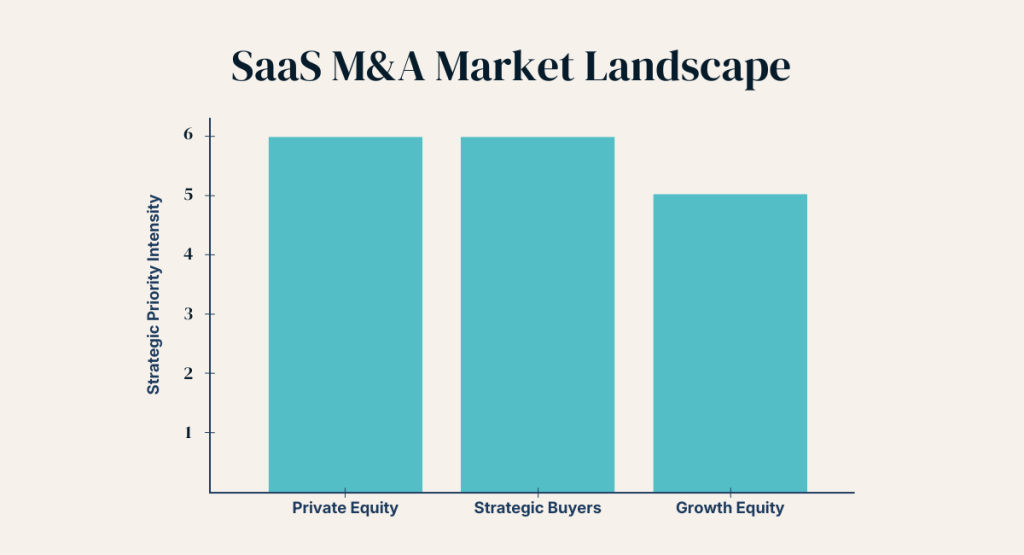
SaaS remains one of the most active segments in lower middle market M&A, with transactions structured in a variety of ways. One notable shift in the current market is how private equity firms approach SaaS investments. Many are focused on building platform companies, using a strong SaaS business as a foundation for additional acquisitions.
These firms typically look for businesses with durable recurring revenue, clear growth potential, and scalability. They also value strong management teams, differentiated products or services, and a demonstrated track record of performance. When those elements are in place, buyers are often willing to pay a premium.
Strategic acquirers are also active in the SaaS market. They tend to pursue acquisitions that complement their existing operations, expand product capabilities, or strengthen their competitive position. Fit and integration potential are key considerations.
Public SaaS market valuations continue to influence private transactions. Higher public multiples and strong investor demand can support valuation expectations across the broader SaaS landscape.
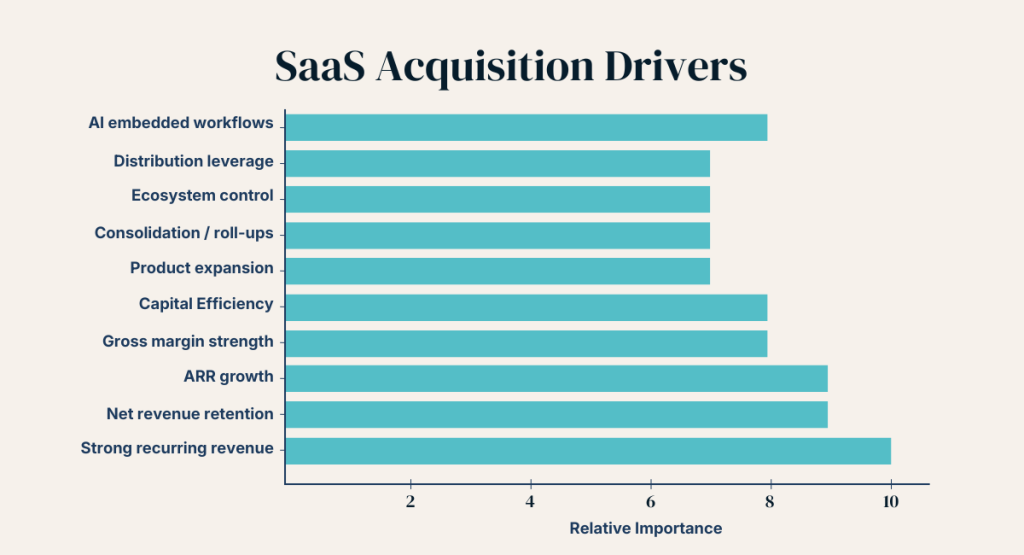
SaaS M&A is typically driven by strategic rationale rather than short-term gain. Acquisitions can accelerate scale more quickly than organic growth alone and allow companies to expand capabilities in a shorter time frame.
Product expansion is one of the primary drivers. Acquiring complementary products or services can enhance an existing offering and support revenue growth and margin improvement.
Consolidation also plays a significant role. Many vertical SaaS segments remain fragmented, creating opportunities for roll-ups and market consolidation.
In certain cases, underperforming SaaS companies may still attract interest, particularly if they possess strong talent, proprietary technology, or valuable intellectual property, even if profitability has not yet been achieved.
The key distinction is whether a transaction is structured as a platform investment or a bolt-on acquisition, and ensuring valuation reflects that positioning.
Bolt-on acquisitions are businesses added to an existing platform. They are often acquired at lower multiples because value is expected to be created through integration with the broader platform. The combined entity may benefit from shared infrastructure, cross-selling opportunities, and operational efficiencies.
The primary valuation metric for SaaS companies is Annual Recurring Revenue, or ARR. Monthly Recurring Revenue is also important because it provides a clear view of predictable monthly income and overall performance. Buyers pay close attention to both metrics during due diligence.
For high-growth SaaS businesses, enterprise value to revenue is typically the most relevant multiple. For more mature companies generating meaningful profitability, enterprise value to EBITDA becomes more important.
Several key factors influence the multiple buyers are willing to pay.
Revenue growth rate is one of the most significant drivers of valuation. Companies growing at 30 percent or more tend to attract broader buyer interest and stronger competitive dynamics.
Net revenue retention above 120 percent signals strong expansion revenue and durable customer relationships. That level of retention is often viewed as a sign of product-market strength.
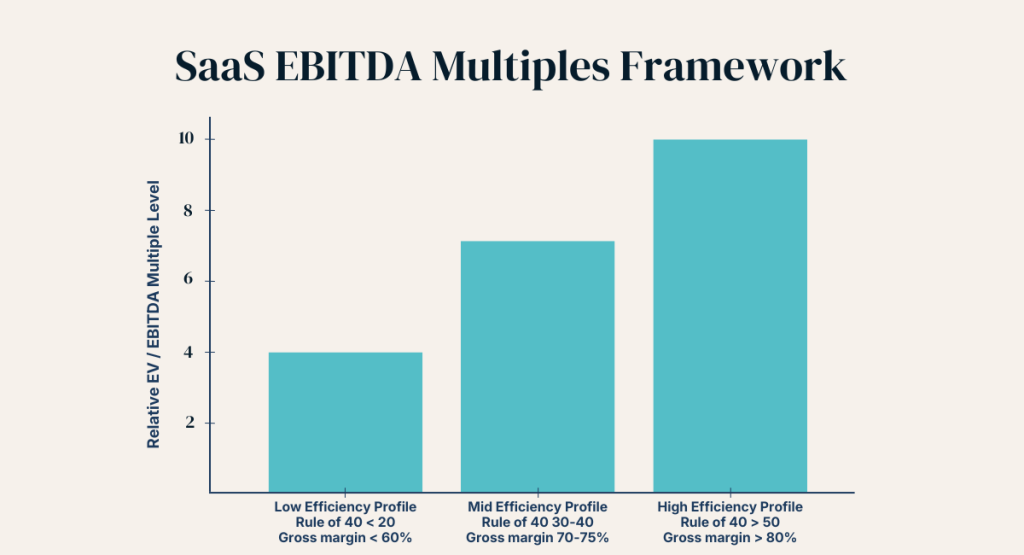
Gross margin is also critical. Higher margins provide greater flexibility for reinvestment and profitability, which is attractive to private equity and strategic buyers.
The Rule of 40, which combines revenue growth rate and EBITDA margin, is often used as a quick indicator of performance and efficiency.
Capital efficiency also plays an important role. Buyers assess how much cash the business consumes and how quickly acquisition costs are recovered. Metrics such as customer acquisition cost and burn rate help frame that analysis.
Companies focused on a specific industry vertical may command a premium if they demonstrate strong retention and defensible positioning. On the other hand, businesses with significant services revenue or month-to-month contracts may see valuation adjustments to reflect revenue predictability and durability.
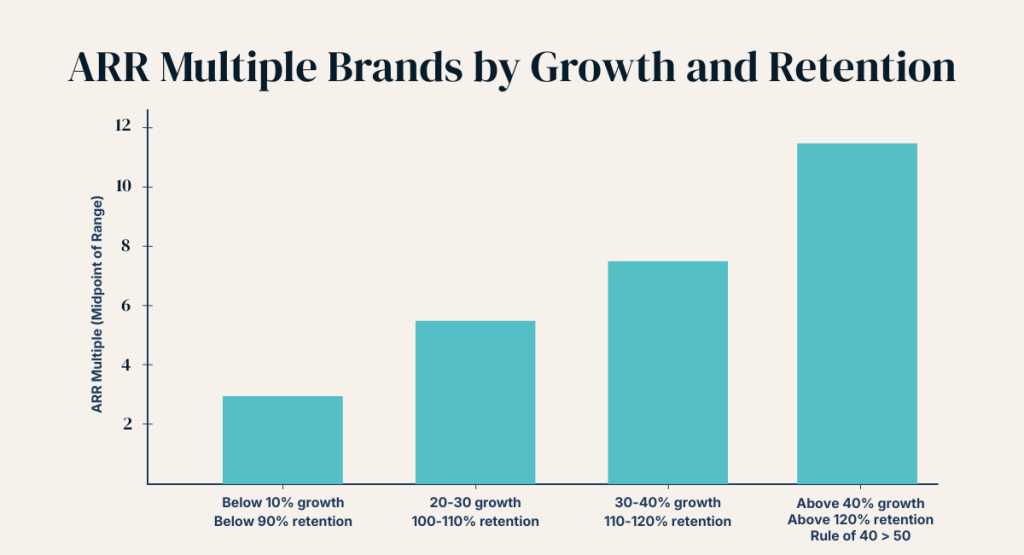
Below is a general guide to potential valuation ranges based on growth rate and customer retention. Actual outcomes depend on market conditions, size, and buyer dynamics.
If growth is below 10 percent and customer retention is under 90 percent, valuations often fall in the 2x to 4x ARR range.
If growth is between 20 and 30 percent and net revenue retention is between 100 and 110 percent, valuations may range from 4x to 7x ARR.
If growth reaches 30 to 40 percent and retention is between 110 and 120 percent, valuations can move into the 6x to 9x ARR range. Companies serving enterprise customers with low churn may achieve a premium within that band.
For businesses growing above 40 percent with retention above 120 percent and a Rule of 40 score exceeding 50, valuations can reach 9x to 14x ARR or higher, depending on company size and broader market conditions.
Some buyers use a scoring model to quickly estimate how valuable a company might be. Here’s one way of doing it:
Net Revenue Retention
Score 1 if retention is below 90 percent, 3 if it falls between 100 and 110 percent, and 5 if it exceeds 120 percent. Strong expansion within the existing customer base signals durable growth.
Growth Rate
Score 1 if growth is under 10 percent, 3 if it ranges between 20 and 30 percent, and 5 if it exceeds 40 percent. Higher growth typically increases buyer interest and competitive tension.
Rule of 40
Score 1 if the metric is below 20, 3 if it falls between 30 and 40, and 5 if it exceeds 50. Many private equity buyers use this as a quick indicator of balance between growth and profitability.
Gross Margin
Score 1 if gross margin is below 60 percent, 3 if it ranges between 70 and 75 percent, and 5 if it exceeds 80 percent. Higher margins provide greater flexibility and support stronger economics.
Customer Acquisition Cost Payback
Score 1 if payback exceeds 24 months, 3 if it falls between 15 and 18 months, and 5 if it is under 12 months. Faster payback reflects more efficient capital deployment.
Customer Concentration
Score 1 if the largest customer represents more than 20 percent of revenue, 3 if no customer exceeds 10 percent, and 5 if revenue is well diversified.
Customer Lifetime
Score 1 if average lifetime is below 12 months, 3 if it ranges between 24 and 36 months, and 5 if it exceeds 48 months. Longer lifetimes typically indicate stronger retention and recurring value.
Revenue Quality
Score 1 if most revenue is services-based, 3 if there is a mix of services and subscription, and 5 if the business is primarily subscription-based with annual prepayments.
If the total score falls between 30 and 35, the company is likely to attract significant buyer interest and potentially achieve a premium valuation. Scores between 22 and 29 may generate interest from private equity and select strategic buyers, though premiums are less likely. Scores below 22 can make a sale more challenging and may result in lower valuation expectations.
Strategic buyers often look to expand their ecosystems, add complementary products, and gain access to valuable data. They may be willing to pay a premium when an acquisition accelerates their roadmap or creates new cross-selling opportunities within their existing customer base. In the current market, both financial and strategic buyers are focused on companies that demonstrate strong growth, clear profitability, scalability, and strategic fit. They evaluate core metrics, customer retention, and market positioning before moving forward with an offer.
Private Equity Firms & The Importance of Predictable Cash Flow
Private equity firms typically prioritize predictable cash flow, margin expansion, and a repeatable go-to-market model. They play a significant role in the SaaS M&A market and assess acquisitions based on revenue quality, growth potential, and opportunities for operational improvement. Competition between private equity firms and strategic buyers is common for high-performing SaaS assets.
Valuation is closely linked to a company’s ability to support leverage, expand margins, and meet performance benchmarks such as the Rule of 40.
Growth Equity Investors: A Different Animal
Growth equity investors generally provide minority capital to extend runway, improve efficiency metrics, and position the company for a larger transaction in the future. In some cases, they also introduce strategic partners who can contribute operational expertise and long-term value creation.
Strategic buyers focus on integration potential, customer expansion, and strengthening competitive positioning. Private equity firms emphasize EBITDA performance and debt capacity. Growth equity investors concentrate on accelerating growth and expanding market share.
For founder-led companies, achieving a strong valuation often comes down to running a disciplined process.
The exit planning phase typically takes two to four months. This involves preparing financials, shaping a clear positioning narrative, and identifying the right buyer universe. Investment banks and advisory firms play an important role here, helping founders position the company, organize financial information, and prepare for a confidential sale process.
The marketing phase follows. Advisors approach qualified buyers confidentially, coordinate management presentations, and gather initial indications of interest.
Once a serious buyer emerges, negotiation of the letter of intent begins. This stage covers valuation, deal structure, rollover equity, earn-outs, and exclusivity terms.
Diligence generally lasts 60 to 90 days. Buyers conduct detailed reviews of financial performance, revenue quality, technology, legal matters, and operational processes.
The final stage is closing. This includes working capital adjustments, escrow arrangements, equity rollovers, and execution of the purchase agreement.
Due diligence for SaaS companies covers several focused areas, beginning with a detailed financial review. This typically includes ARR bridge analysis to understand revenue movement, customer retention performance, revenue recognition policies, and the overall accuracy and consistency of financial reporting.
Commercial diligence examines the customer base and go-to-market engine. Buyers assess customer composition, pipeline strength, whether growth is driven by new logo acquisition or expansion within the existing base, and how engagement levels influence satisfaction, retention, and upsell potential.
Product and technology diligence focuses on scalability and defensibility. This includes evaluating the technical architecture, security posture, AI integration, technical debt, data analytics capabilities, and data protection practices to ensure compliance with privacy regulations and enterprise security standards.
Legal diligence reviews intellectual property ownership, customer contract structure, renewal mechanics, termination provisions, and other obligations that could affect risk or valuation.
SaaS transactions typically involve a mix of cash and equity. An all-cash structure provides immediate liquidity to the seller. Rollover equity, by contrast, aligns management with the buyer, often a private equity platform, and may create the opportunity for a second liquidity event.
Earn-outs are commonly used when buyer and seller differ on forward revenue projections. These structures are usually tied to performance targets such as ARR, net revenue retention, or EBITDA milestones.
Working capital adjustments require careful attention in SaaS transactions, particularly where deferred revenue materially affects the balance sheet.
Escrow arrangements generally involve withholding 5 to 15 percent of the transaction value to cover indemnification obligations.
Private equity-backed transactions typically involve the sponsor contributing 40 to 60 percent of the total equity, with the remainder supported by ARR-based lending or unitranche financing structures.
Interest rate conditions directly influence leverage capacity. When rates rise, the amount of debt buyers can prudently deploy tends to decrease. However, businesses with strong gross margins and durable retention profiles often generate greater lender confidence, which can support more favorable financing terms.
Integration begins immediately after closing. Day one priorities usually include communicating clearly with customers, retaining key employees, and ensuring consistent market messaging.
Within the first 30 to 100 days, attention shifts to pricing alignment, integration of go-to-market functions, and identifying cross-sell opportunities across the combined customer base.
Over the longer term, value creation typically comes from consolidating technology platforms, standardizing operational processes, and executing additional bolt-on acquisitions.
Vertical SaaS companies often benefit from higher retention, stronger pricing power, and greater defensibility due to deep domain expertise and tailored solutions. This can support a durable market position that appeals to both customers and investors. The trade-off is a narrower total addressable market.
Horizontal SaaS companies typically operate in larger markets but face broader competition and potentially higher churn risk.
Roll-up strategies frequently focus on vertical segments where defensibility is strong and operational standardization can support multiple expansion at exit.
The market has shifted from prioritizing growth at any cost to rewarding efficient growth. CAC payback, burn multiple, free cash flow generation, and Rule of 40 performance now meaningfully influence valuation. Buyers place a premium on capital efficiency and discount businesses with unsustainable cash burn or unclear paths to profitability.
Adding surface-level AI features does not automatically justify a premium valuation.
However, when AI is embedded directly into core workflows, supported by proprietary data, and tied to measurable customer outcomes, it can materially enhance value. Buyers assess the depth of automation, defensibility of training data, and evidence of real productivity gains.
The integration of AI into areas such as marketing automation and ERP systems is increasingly viewed as a driver of operational efficiency and competitive differentiation within SaaS M&A.
Preparing 12 to 24 months before an exit can have a meaningful impact on valuation.
At that stage, the priority is strengthening the fundamentals. This includes reducing customer concentration, improving net revenue retention, standardizing pricing, tightening contract terms, and building a leadership team with depth beyond the founder. Retaining key employees is especially important. Clear employment agreements and continuity planning help reduce perceived risk and strengthen buyer confidence.
Six to twelve months before launching a process, attention should shift toward improving customer acquisition cost payback, refining forecasting accuracy, upgrading financial reporting, and reinforcing operational discipline. The goal is to ensure the business can withstand detailed buyer scrutiny.
In the final three to six months before going to market, preparation becomes more tactical. The data room should be complete and organized. KPIs should be normalized and clearly presented. The positioning narrative should be defined, and the target buyer universe mapped in advance.
Exit readiness is one of the most controllable drivers of a premium outcome.
SaaS transactions carry recurring risks, including customer concentration, services revenue masking churn, weak contract structures, misaligned earn-outs, cultural integration challenges, and financial normalization errors.
Early, disciplined preparation and experienced advisory support can materially reduce these risks and improve the likelihood of a strong valuation outcome.
Strategic Acquisition Example: Adobe & Figma
Adobe acquired Figma for strategic positioning. The objective was to expand into a complementary space, strengthen ecosystem control, and deepen engagement with the developer community.
Key performance indicators included strong revenue growth, high net revenue retention, expanding enterprise adoption, and less emphasis on short-term profitability. Market timing also played a role, as both parties were operating in a favorable SaaS valuation environment.
The transaction reflected a premium valuation driven primarily by strategic fit rather than EBITDA performance.
Post-acquisition, the focus centered on distribution leverage, enterprise cross-sell opportunities, and deeper ecosystem integration.
Private Equity Platform Example: Thoma Bravo
Thoma Bravo targets SaaS businesses with durable recurring revenue, opportunities for margin expansion, and bolt-on acquisition potential.
Key performance indicators typically include gross margins above 80 percent, strong retention, predictable ARR, and stable growth.
Transactions often involve leverage supported by cash flow, management rollover equity, and performance-based incentives.
Post-close value creation generally focuses on pricing optimization, operational efficiency, and executing add-on acquisitions.
Roll-Up Strategy Example: Vista Equity Partners
Vista Equity Partners builds vertical platforms through multiple bolt-on acquisitions.
At entry, attractive characteristics typically include strong retention, scalable architecture, and fragmented competitive landscapes.
Value creation is driven by pricing alignment, cross-sell integration, operational standardization, and multiple expansion at exit.
Growth Equity Pre-Exit Example
Growth equity investors provide minority capital to accelerate go-to-market efficiency and improve Rule of 40 performance ahead of a larger transaction.
Key performance indicators often include strong top-line growth, improving retention, and under-optimized CAC payback.
These transactions typically involve minority investment, board participation, and alignment toward a future strategic or private equity exit.
Value creation centers on sales efficiency improvements, margin expansion, and strengthening exit positioning. Capital may also support product development and market expansion ahead of a full sale.
Valuation multiples for SaaS companies can range from 2x ARR to 14x or higher, depending on growth rate, retention strength, capital efficiency, vertical positioning, and overall market conditions.
A typical SaaS sale process takes six to twelve months, including preparation, marketing, diligence, and closing.
Buyers prioritize net revenue retention, ARR growth, Rule of 40 performance, gross margin strength, and capital efficiency. A stable and satisfied customer base also matters. Strong retention and low churn signal operational stability and support higher valuation multiples.
Strategic buyers focus on synergy, ecosystem expansion, and distribution leverage. Private equity buyers focus on durability, leverage capacity, and operational scalability.
AI capabilities influence valuation only when they are embedded into core workflows, supported by proprietary data, and tied to measurable outcomes. Surface-level features alone do not drive premium valuations.
B2B SaaS M&A advisory is a specialized form of sell-side investment banking focused on representing software-as-a-service companies in sale transactions. The advisor builds a qualified buyer universe of PE firms, strategic acquirers, and growth equity funds, manages confidential outreach, creates competitive tension among multiple parties, and negotiates transaction terms including valuation, earnout structure, and retention arrangements. The advisory firm acts exclusively on the seller’s behalf throughout the process.
SaaS companies with strong recurring revenue profiles are valued on ARR multiples rather than EBITDA multiples. The primary valuation drivers are annual recurring revenue quality, net revenue retention rate, gross margin profile, logo and revenue churn rates, customer concentration, and growth trajectory. A SaaS company with $5M in ARR, 115% NRR, and 75% gross margins may command a significantly higher valuation on an ARR-multiple basis than what an EBITDA-based methodology would produce.
Windsor Drake advises B2B SaaS companies with enterprise values between $5 million and $300 million, typically generating $1M–$20M in ARR or EBITDA. This range spans companies with established product-market fit and measurable SaaS metrics through institutional-scale platforms with audited financials and diversified customer bases.
Windsor Drake advises across nine SaaS verticals: fintech SaaS (payments, lending technology, regtech), healthcare SaaS (RCM, practice management, compliance), vertical SaaS (industry-specific platforms), cybersecurity SaaS (IAM, compliance automation), HR tech and workforce SaaS (payroll, ATS, workforce management), logistics and supply chain SaaS (TMS, WMS, procurement), EdTech SaaS (B2B learning platforms, compliance training), PropTech SaaS (commercial property management, lease administration), and GovTech SaaS (municipal systems, public sector compliance).
A structured sell-side process for a B2B SaaS company typically spans 6 to 12 months from engagement to closing. Timeline drivers include buyer universe complexity, depth of technical and financial due diligence, whether the transaction involves cross-border elements, and the complexity of IP assignment and customer contract transfer.
The buyer universe includes three categories: financial sponsors (private equity and growth equity firms with dedicated SaaS platform theses and active add-on acquisition mandates), strategic acquirers (larger software companies seeking product expansion, customer base consolidation, or geographic market entry), and family offices with technology-focused investment mandates. A well-structured process engages all three categories to maximize competitive tension and valuation outcomes.
Windsor Drake runs institutional-grade competitive sale processes. Business brokers list companies on marketplaces and wait for inbound interest. Windsor Drake builds a targeted buyer thesis specific to each SaaS client, directly approaches 50–100+ qualified acquirers under confidentiality, creates competitive tension among multiple parties, and negotiates deal terms, including ARR-based valuation, earnout structure, and management retention, through a structured process managed by a senior advisor from engagement to close.
The optimal engagement window is 12 to 24 months before a target transaction date. Early engagement allows the advisor to identify ARR quality improvements, resolve customer concentration issues, restructure contracts for assignability, reduce churn, clean up the cap table, and build the buyer universe before a formal process launches. Founders who engage early consistently achieve stronger multiples and better deal terms than those who begin preparation after deciding to sell.
SaaS M&A – where preparation is everything
Strong outcomes in SaaS M&A are rarely accidental. Founder-led companies that execute successfully prepare well in advance. They refine their KPIs, develop a clear positioning narrative, define the right buyer universe, create competitive tension, and run a structured negotiation process.
At Windsor Drake, we work closely with founders to manage confidential sell-side processes designed to maximize value, preserve control, and align with long-term strategic objectives.
Selling your SaaS business is not just about having strong numbers, although that is the starting point. It also requires a clear understanding of what makes your company attractive to buyers and consistent focus on the metrics that drive value in today’s market. Private equity and strategic acquirers look for durable recurring revenue, efficient customer acquisition, and high retention. Founders who prepare early are typically better positioned when opportunities arise.
Operational discipline matters. Clear reporting, strong unit economics, and readiness for detailed diligence all contribute to stronger outcomes. A structured process, competitive buyer outreach, and disciplined negotiation can materially influence valuation. Experienced advisory support helps manage that process while protecting confidentiality and control.
At Windsor Drake, we advise lower middle-market SaaS founders through confidential sell-side processes designed to maximize value and align with long-term objectives. As the SaaS market continues to evolve, preparation and disciplined execution remain the most reliable drivers of a successful exit.
Related from Windsor Drake