Home / Sell-Side M&A / SaaS Business Metrics for M&A 2024
SaaS businesses are measured differently because revenue recurs and compounds over time. Sustainable growth is a core strategic objective, ensuring long-term resilience in competitive markets.
Growth metrics help evaluate durability, predictability, and capital efficiency — the factors that ultimately determine long-term value and valuation outcomes. Modern SaaS rewards efficient growth. In 2026, the focus has shifted away from “growth at all costs” toward disciplined, capital-aware expansion. The right strategies support sustainable growth and stronger business value.

One month of bookings doesn’t tell you much in SaaS. Cohort analysis shows whether revenue holds steady, expands, or declines over time — and whether growth is truly durable.
When retention, payback, and expansion metrics are consistent, revenue becomes easier to forecast. Greater predictability lowers perceived risk. Clear, data-driven insight supports stronger valuations and more confident strategic decisions.
The market now values efficiency alongside growth. Companies that pair strong retention with disciplined acquisition spending tend to outperform those that pursue expansion at any cost. Durable, capital-efficient growth commands premium outcomes.
When evaluating a SaaS business, we don’t rely on a single headline metric. We use a framework. The goal is to determine whether growth is genuine, repeatable, and efficient. Performance metrics provide the foundation for benchmarking against peers, identifying improvement areas, and ensuring the business can withstand investor or buyer scrutiny.
To stay competitive, these metrics should be monitored through real-time dashboards rather than static annual surveys.
Revenue quality is about how reliable your ARR really is. We look at recurring versus non-recurring revenue, contract structure, customer concentration, discounting, and any usage or services components that introduce volatility. Clean, well-defined ARR is easier to forecast and easier to underwrite.
Revenue quality is about how reliable your ARR really is. We look at recurring versus non-recurring revenue, contract structure, customer concentration, discounting, and any usage or services components that introduce volatility. Clean, well-defined ARR is easier to forecast and easier to underwrite.
Retention and expansion determine whether revenue compounds, with existing customers playing a critical role in driving SaaS revenue growth and retention. We track churn, GRR, NRR, and expansion revenue, ideally segmented by customer size, tier, and acquisition channel. Strong retention reduces risk. Strong expansion increases lifetime value and supports premium valuation outcomes. Expansion revenue is more efficient than revenue from new customers.
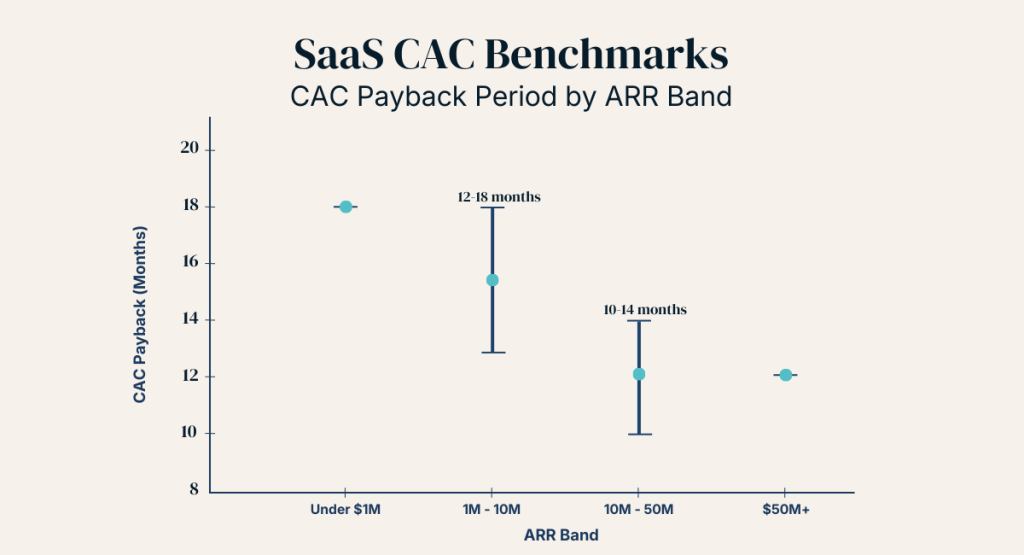
Growth efficiency measures how effectively you convert sales and marketing spend into net new ARR, with marketing costs being a significant component of CAC and something that should be closely monitored. Metrics like sales efficiency, CAC payback, and the SaaS magic number help show whether growth is getting more efficient as you scale. Buyers want to see that the model improves with size, not the opposite. Notably, Customer Acquisition Costs (CAC) have increased by 1.6X in 2024 year-over-year, underscoring the need for ongoing optimization.
Capital efficiency connects growth to cash. We look at burn multiple, burn rate, runway, and revenue per employee to understand how much capital the business consumes to generate ARR, with ‘ARR per’ emerging as a key metric for measuring productivity and efficiency within SaaS companies. The best SaaS companies improve capital efficiency over time, which creates flexibility and stronger outcomes.
ARR per employee continues to increase as companies scale, reflecting improved operational efficiency. Companies are focusing on operating expense and headcount control to optimize ARR per employee, while increasingly leveraging automation to enhance productivity and reduce dependency on higher-cost resources.
Use these five pillars as the structure for your dashboard and reporting. When each pillar is clear and consistently measured, the business becomes easier to run, forecast, and value.
MRR is the monthly value of your active subscription revenue. It’s the baseline number we use to understand how revenue is building over time.
Formula
MRR = Σ (active customers × monthly subscription price)
MRR movement
Ending MRR = Beginning MRR
ARR is MRR annualized. It’s the most common anchor metric used in SaaS planning, benchmarking, and valuation discussions.
Formula
ARR = MRR × 12
or the annualized value of recurring contracts
ARPU tells you how much recurring revenue you earn per active customer. It’s most useful when segmented by tier, customer size, or channel.
Formula
ARPU = MRR ÷ total active customers
ACV is the average annual value of a customer contract, and annual contract value is a key metric for analyzing SaaS performance. It helps set expectations for sales cycle length, CAC, payback, and retention.
FormulaACV = total contract value ÷ contract length in years
Metrics such as Gross Revenue Retention Rate (GRR), CAC ratios, and CAC payback periods often vary based on the value and length of annual contracts.
The average annual NRR rate for SaaS companies is reported to be between 95% and 115%.
CAC measures the fully loaded cost to acquire a new customer, making it essential to track and optimize all costs involved in customer acquisition. We always calculate it using total sales and marketing spend, not just paid media.
Formula
CAC = total sales and marketing spend ÷ new customers acquired
Include salaries, tools, commissions, and paid media for fully loaded CAC.
CAC payback tells you how long it takes to recover CAC from gross profit. This is a core efficiency metric in both fundraising and M&A underwriting.
Formula
CAC payback (months) = CAC ÷ (ARPU × gross margin)
Conversion rate measures how efficiently leads turn into customers. For decision-making, we prefer stage-level conversion rather than one blended number.
Formula
Conversion rate = new customers ÷ total leads
Segment by funnel stage for deeper insight.
Logo churn measures the percentage of customers you lose over a period. It’s a useful health check, but it should be paired with revenue churn.
Formula
Logo churn = customers lost ÷ customers at start of period
Revenue churn shows how much recurring revenue you lose to churn. It’s more economically meaningful than logo churn when customer sizes vary.
Formula
Revenue churn = churned MRR ÷ beginning MRR
GRR measures how much revenue you retain before expansion. It isolates churn and contraction, which makes it a clean indicator of revenue durability.
Formula
GRR = (beginning MRR − churn − contraction) ÷ beginning MRR
NRR measures retained revenue, including expansion. It’s one of the most important metrics buyers use to assess whether revenue compounds.
Formula
NRR = (beginning MRR + expansion − churn − contraction) ÷ beginning MRR
LTV estimates the gross profit generated by a customer over their lifetime. The simplified version is useful for directional planning, but we prefer the gross margin–adjusted version.
Simple formula
LTV = ARPU ÷ churn rate
Gross margin adjusted
LTV = (ARPU × gross margin) ÷ churn rate
LTV:CAC shows whether customer economics support scaled growth. A ratio around 3x is often considered efficient, but interpretation depends on your ACV and payback profile.
Formula
LTV:CAC = LTV ÷ CAC
Interpretation
Gross margin measures how much revenue remains after delivering the service. Higher gross margin typically supports stronger reinvestment capacity and better valuation outcomes.
Formula
Gross margin = (revenue − cost of service) ÷ revenue
The magic number estimates how efficiently sales and marketing spend translates into ARR growth. Definitions vary, so the key is to apply one method consistently.
Formula
Magic number = (current quarter ARR − previous quarter ARR) × 4 ÷ previous quarter S&M spend
Sales efficiency is a simpler version of the same idea. It tells you how much net new ARR you generate per dollar of sales and marketing spend.
Formula
Sales efficiency = net new ARR ÷ sales and marketing spend
Burn multiple measures how much cash you burn to generate net new ARR. It’s a core metric for capital efficiency and is widely used by investors.
Formula
Burn multiple = net burn ÷ net new ARR
The Rule of 40 is a shorthand performance metric for SaaS. It combines growth and profitability into one score.
Formula
Rule of 40 = growth rate % + EBITDA margin %
Burn rate measures how much cash the business consumes each month. It’s the starting point for runway planning.
Formula
Burn rate = monthly operating expenses − monthly revenue
Runway estimates how many months you can operate before cash runs out at your current burn.
Formula
Runway (months) = cash balance ÷ monthly burn
Revenue per employee measures operating leverage. Over time, strong SaaS businesses typically improve this metric as scale increases.
Formula
Revenue per employee = ARR ÷ total headcount
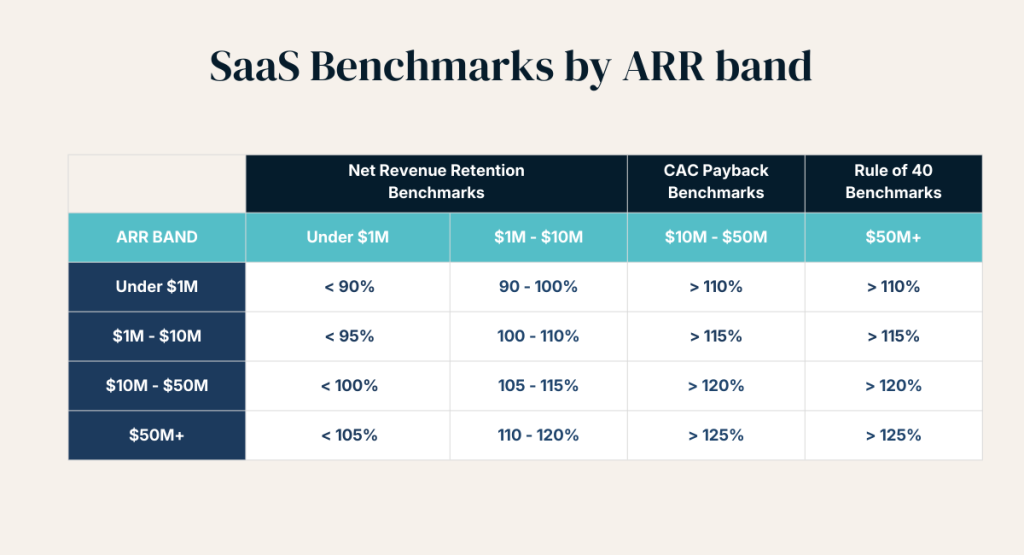
| ARR band | Poor | Good | Elite |
| Under $1M | <90% | 90–100% | >110% |
| $1M–$10M | <95% | 100–110% | >115% |
| $10M–$50M | <100% | 105–115% | >120% |
| $50M+ | <105% | 110–120% | >125% |
| ARR band | Target |
| Under $1M | <18 months |
| $1M–$10M | 12–18 months |
| $10M–$50M | 10–14 months |
| $50M+ | <12 months |
| Stage | Healthy range |
| Early stage | 2–3x |
| Growth stage | 3–4x |
| Scale stage | 3–5x |
| Stage | Efficient | Average | Inefficient |
| Early | < 2 | 2–3 | > 3 |
| Growth | < 1.5 | 1.5–2 | >2 |
| Scale | <1 | 1–1.5 | >1.5 |
| Performance | Score |
| Below standard | < 20% |
| Competitive | 20–40% |
| Top quartile | >40% |
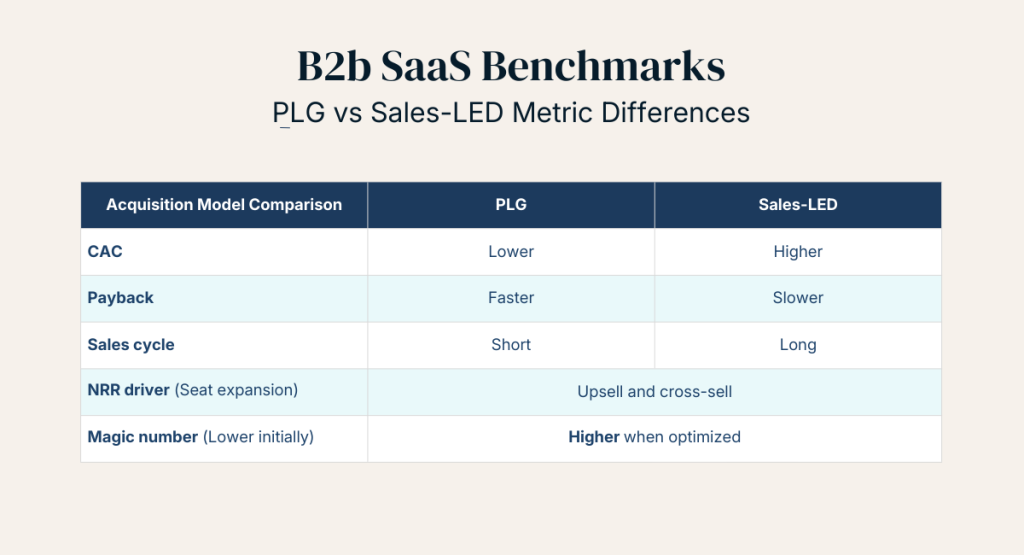
| Metric | PLG | Sales-led |
| CAC | Lower | Higher |
| Payback | Faster | Slower |
| Sales cycle | Short | Long |
| Primary driver | Product usage (often supported by free trials that attract users and enable meaningful product interactions, which are essential for incremental growth) | Sales team |
| Metric | PLG | Sales-led |
| NRR driver | Seat expansion; net new revenue from initial product interactions is a key metric for measuring the effectiveness of product-led growth strategies | Upsell and cross-sell |
| Churn risk | Usage-dependent | Contract-based |
| Expansion timing | Continuous | Renewal-driven |
| Metric | PLG | Sales-led |
| NRR driver | Seat expansion; net new revenue from initial product interactions is a key metric for measuring the effectiveness of product-led growth strategies | Upsell and cross-sell |
| Churn risk | Usage-dependent | Contract-based |
| Expansion timing | Continuous | Renewal-driven |
| Metric | PLG | Sales-led |
| Magic number | Lower initially | Higher when optimized |
| LTV:CAC | Potentially very high | Stable and moderate |
| Revenue per employee | Higher | Lower |
Early stage
Growth stage
Scale stage
A strong SaaS business needs a reporting stack that is clean, consistent, and defensible. Each system should have a clear role so there is no confusion about where numbers originate or how they are calculated. A well-structured stack also makes it easier to benchmark performance against industry standards and understand how your metrics compare to peers.
Your billing platform should serve as the single source of truth for MRR and ARR. Subscription status, upgrades, downgrades, churn, and contract terms should all flow directly from this system. If ARR cannot be reconciled to billing data, forecasting and diligence quickly become complicated.
Your CRM should track pipeline, bookings, win rates, and sales cycle length. It shows how revenue is generated and how efficiently deals convert. Clean CRM data makes it possible to connect acquisition costs to actual closed ARR.
Product analytics tools measure activation, feature adoption, usage patterns, and engagement depth. These insights help explain why customers retain or churn and connect product behavior to revenue performance.
Your financial model should integrate billing, CRM, and product data into cohort-based forecasting. This is where churn, expansion, payback, and growth scenarios are modeled. A well-built model turns metrics into forward-looking decisions rather than backward-looking reports.
The Bessemer Efficiency Score is a widely referenced SaaS benchmark that measures the net new ARR generated for each dollar of net burn. A score above 1.5x is generally considered best in class and signals efficient growth.
Another commonly referenced metric is the Cash Conversion Score, which evaluates the return generated on each dollar of capital invested. A score of 1x is often viewed as a strong indicator of product-market fit and scalable sales and marketing execution.
Strong SaaS forecasting is built on retention patterns and revenue mechanics, not just pipeline assumptions. The objective is to understand how ARR is likely to evolve based on customer behavior and acquisition efficiency. Done correctly, metrics-based forecasting provides a clearer view of future revenue and cash flow trends.
ARR waterfall forecasting begins with starting ARR and models the components that move it: new ARR, expansion, contraction, and churn. This structure makes growth drivers transparent and clarifies where performance is coming from.
Cohort modeling tracks customers by start date and measures how revenue changes over time. Stable retention curves improve forecast credibility. If cohorts weaken as you scale, growth assumptions should be revisited.
Scenario planning tests how sensitive the model is to changes in churn, acquisition cost, or expansion timing. Even modest shifts in retention or payback can materially affect cash flow and valuation outcomes.
Forecasting often breaks down when companies rely too heavily on pipeline assumptions or blended averages. Overlooking cohort trends, miscalculating fully loaded CAC, or failing to reconcile ARR to billing data can distort performance.
Tracking the right metrics consistently helps avoid these issues and keeps benchmarks accurate and actionable.
Effective SaaS forecasting is grounded in retention behavior and revenue mechanics, not just pipeline targets. The goal is to model how ARR changes over time based on churn, expansion, and acquisition efficiency.
Including a benchmark chart can help visually compare key financial and operational metrics, such as gross margins and operating expenses, against industry medians.
Use advanced dashboards to benchmark your SaaS performance against peers for deeper insights.
ARR or MRR, NRR, CAC, LTV to CAC, churn, and burn multiple. Together, these metrics give a clear picture of growth quality, retention strength, and overall efficiency.
NRR above 100 percent is generally considered strong because expansion revenue offsets churn. Many top-performing B2B SaaS companies target 120 percent or higher, depending on segment and ACV.
A simple approach is ARPU divided by churn rate. A more precise method adjusts for gross margin by multiplying ARPU by gross margin and dividing by churn rate.
For many B2B SaaS companies, 12 to 18 months is a common benchmark. Product-led models often aim for shorter payback periods, while higher-ACV, sales-led models may operate with longer timelines.
The Rule of 40 combines growth rate and profit margin into a single measure. A score of 40 percent or higher is typically viewed as strong performance for SaaS businesses.
The SaaS magic number measures how efficiently sales and marketing spend translates into ARR growth. It is most useful when tracked as a trend over time rather than judged on a single quarter.
ARR represents recurring revenue normalized to an annual run rate. Bookings reflect the total contract value signed, which may include one-time fees, services revenue, or multi-year agreements.
A ratio around 3x is often considered efficient for scalable growth. Below 1x typically indicates customer acquisition is unprofitable. Above 5x can be strong, but it may also suggest the company is under-investing in growth.
Investors typically look at growth rate, retention and expansion such as NRR, unit economics including CAC, payback, and LTV to CAC, and efficiency metrics like burn multiple and Rule of 40. These metrics are often benchmarked against comparable SaaS peers.
A burn multiple below 1.5 is generally viewed as efficient. Below 1.0 is often considered elite, particularly at scale.
Metrics are more than reporting outputs. They inform decisions. The strongest SaaS companies pair durable retention with disciplined acquisition and improving efficiency as they scale. The objective is predictable growth that becomes increasingly capital-efficient over time.
©2026 Windsor Drake