
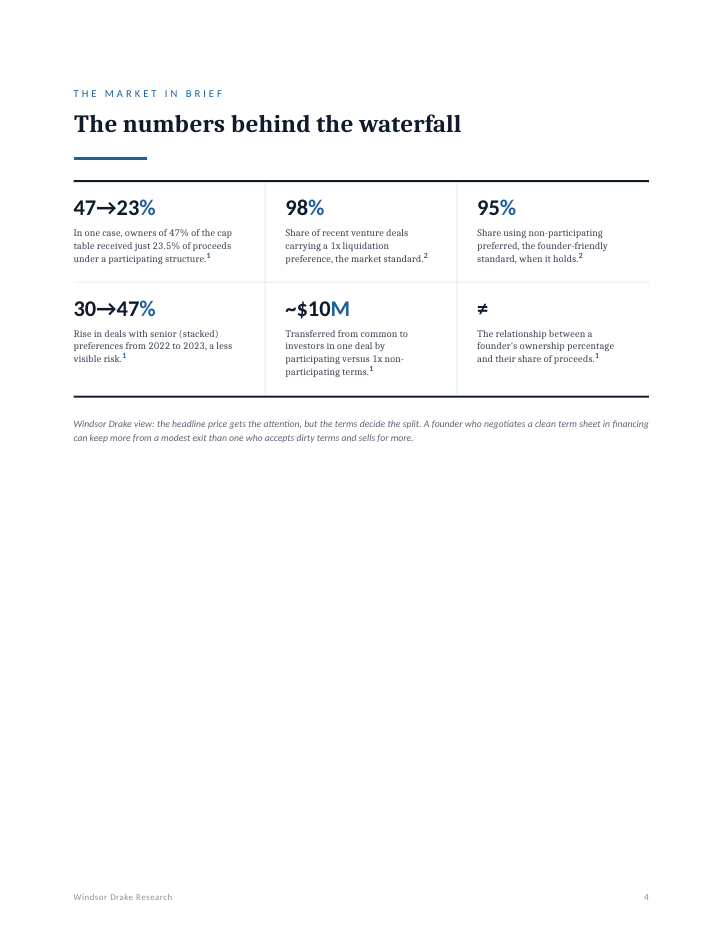
A founder who owns forty percent of a company assumes they will receive forty percent of the proceeds when it sells. They will not. The liquidation waterfall, and the preference terms agreed in financing rounds years earlier, sit between the cap table and the bank account, and they routinely deliver common shareholders far less than their ownership implies.
When a company sells, the proceeds do not split by ownership. They flow through a waterfall defined in the company’s charter, paying claims in a strict order, and common shareholders, the founders and employees, sit at the bottom of it.
Three features of a liquidation preference decide how much it costs common shareholders: its multiple, whether it participates, and how it ranks against other preferences. Each is set in financing, and each can move a founder’s exit by millions.
The ownership-payout gap is the difference between the share of the company a founder owns and the share of the proceeds they receive. It is the central, under-appreciated fact of exit economics, and it is largest exactly where founders least expect it.
The mechanics are clearest with a concrete case. Consider a company that sells for thirty million dollars, having raised twenty million across two rounds, with founders and employees owning half the equity and investors the other half.
The waterfall is only the first of several deductions between the headline price and what a founder banks. The full path runs through the preferences, then the deal structure, then fees, then tax, and the founder’s real number sits at the very end.
Windsor Drake’s research desk compiled this report from transaction data, public filings, and the firm’s sell-side advisory work in software, fintech, AI, and cybersecurity. It is intended to inform founders, owners, and acquirers evaluating a transaction, and does not constitute investment advice.
A look at the exhibits and analysis inside. The complete report is free to read, with no registration required.
The complete report is open. No registration required.
Open the report (PDF)Used only to deliver the report and occasional research. No spam. Unsubscribe anytime.
Why what you own is not what you get. A founder who owns forty percent of a company assumes they will receive forty percent of the proceeds when it sells.
The report draws on 2025 deal activity across the software, fintech, AI, and cybersecurity markets, with Windsor Drake’s outlook for 2026.
It is complimentary. The full report is open on this page as a PDF, with no registration required.
Founders, owners, and shareholders weighing a sale, alongside the acquirers, investors, and journalists who track lower middle market M&A.
For founders acting on these findings, Windsor Drake’s the complete guide to selling your business sets out the detail in practice. The full series is collected in the Windsor Drake Insight Reports library.
Windsor Drake advises founders directly on fintech M&A, cybersecurity M&A, and SaaS valuation.
Our research desk publishes the data founders and acquirers actually use. Browse the full library, or speak with us in confidence.
Explore all researchWindsor Drake represents founders on the sell side only. Every inquiry is read and answered personally, usually within one business day, and every conversation is confidential and without obligation.
Discuss a potential saleWindsor Drake is not a registered broker-dealer and does not offer, sell or place securities.