
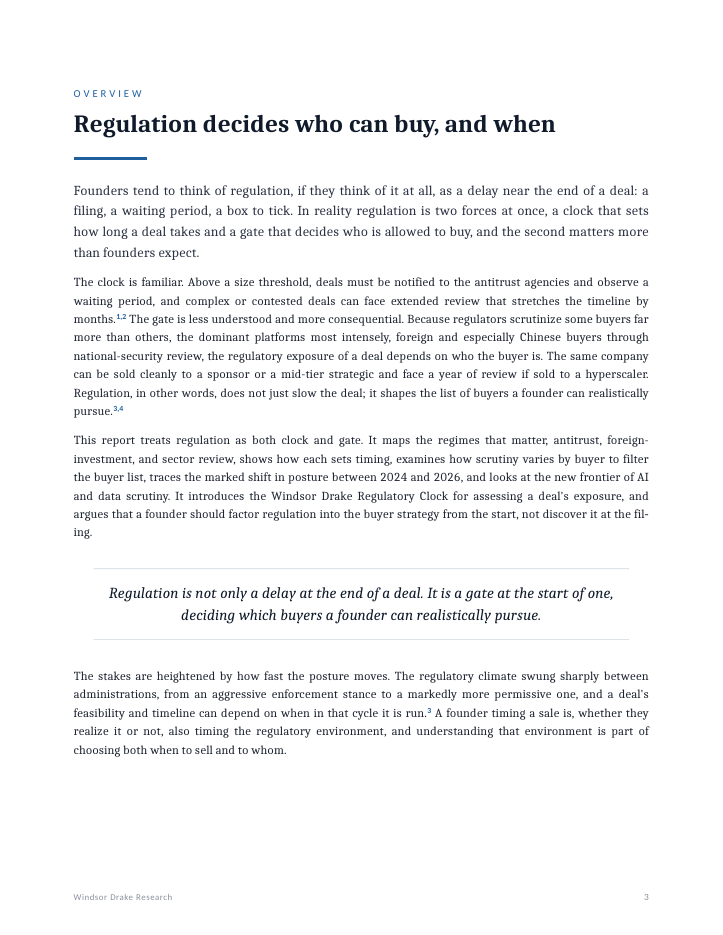
Founders tend to think of regulation, if they think of it at all, as a delay near the end of a deal: a filing, a waiting period, a box to tick. In reality regulation is two forces at once, a clock that sets how long a deal takes and a gate that decides who is allowed to buy, and the second matters more than founders expect.
A technology deal can touch several regulatory regimes at once, each with its own trigger, timeline, and concerns. A founder should know which regimes a given deal implicates, because each adds time and some can block a buyer entirely.
Where regulation applies, it sets the timeline. The waiting periods and reviews are mandatory and largely outside the parties’ control, and for the deals they touch, the regulatory clock often becomes the binding constraint on when a deal can close.
The most under-appreciated effect of regulation is that it does not apply equally to all buyers. Because scrutiny depends on who is buying, regulation filters the buyer list, and the buyers most able to pay a premium are often the most regulated.
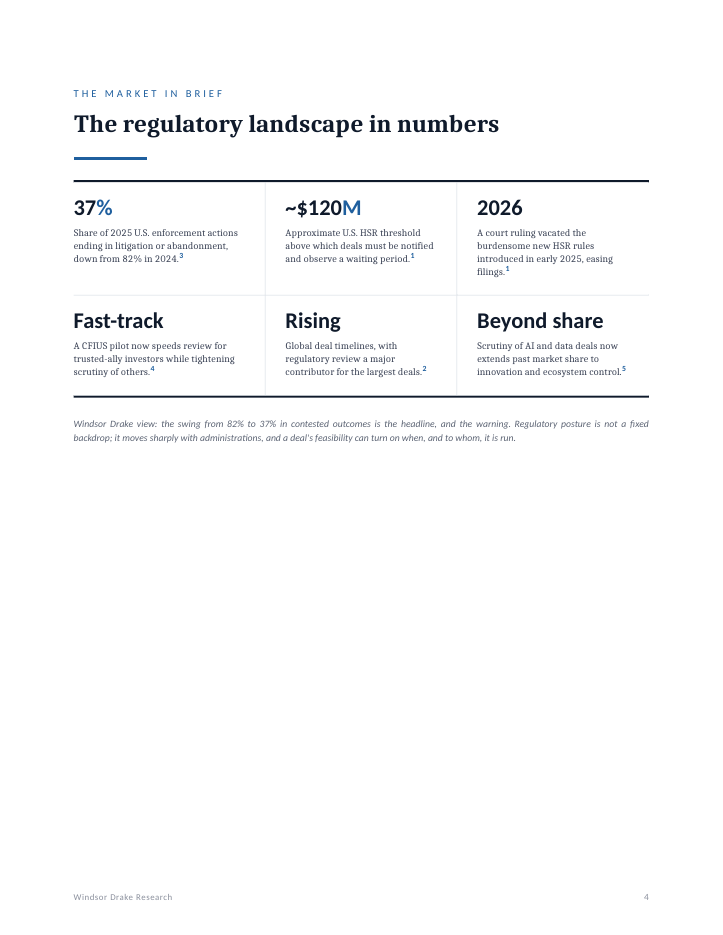
The regulatory posture toward dealmaking swung sharply between 2024 and 2026, from an aggressive enforcement stance to a markedly more permissive one. The swing is good news for current dealmakers and a warning about how fast the environment can change.
The abstract becomes concrete in deals that cleared and deals that died. A short set of recent transactions shows the clock, the gate, and the posture swing operating on real companies.
Windsor Drake’s research desk compiled this report from transaction data, public filings, and the firm’s sell-side advisory work in software, fintech, AI, and cybersecurity. It is intended to inform founders, owners, and acquirers evaluating a transaction, and does not constitute investment advice.
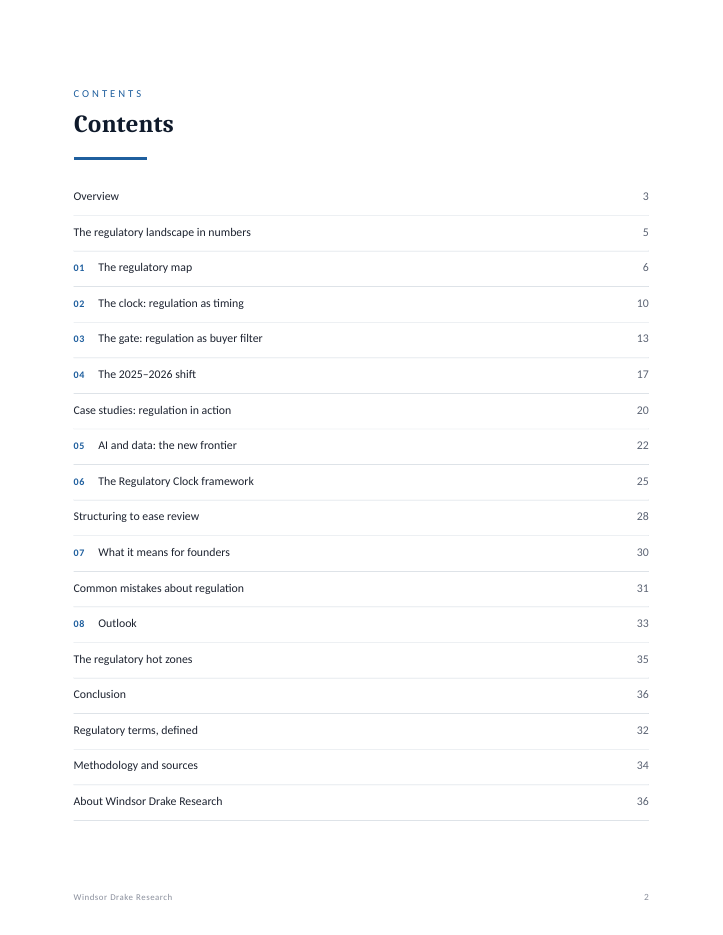
A look at the exhibits and analysis inside. The complete report is free to read, with no registration required.
The complete report is open. No registration required.
Open the report (PDF)Used only to deliver the report and occasional research. No spam. Unsubscribe anytime.
How rules decide who can buy, and when. Founders tend to think of regulation, if they think of it at all, as a delay near the end of a deal: a filing, a waiting period, a box to tick.
The report draws on 2025 deal activity across the software, fintech, AI, and cybersecurity markets, with Windsor Drake’s outlook for 2026.
It is complimentary. The full report is open on this page as a PDF, with no registration required.
Founders, owners, and shareholders weighing a sale, alongside the acquirers, investors, and journalists who track lower middle market M&A.
For founders acting on these findings, Windsor Drake’s the sell-side M&A process sets out the detail in practice. The full series is collected in the Windsor Drake Insight Reports library.
Windsor Drake advises founders directly on fintech M&A, cybersecurity M&A, and SaaS valuation.
Our research desk publishes the data founders and acquirers actually use. Browse the full library, or speak with us in confidence.
Explore all researchWindsor Drake represents founders on the sell side only. Every inquiry is read and answered personally, usually within one business day, and every conversation is confidential and without obligation.
Discuss a potential saleWindsor Drake is not a registered broker-dealer and does not offer, sell or place securities.